
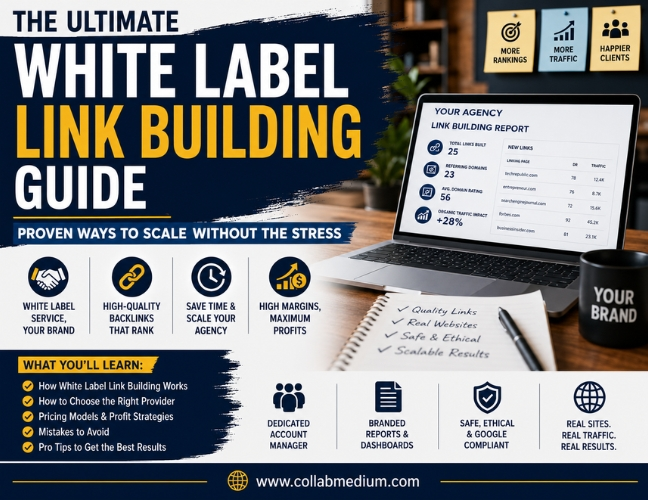
Running a digital agency is rewarding — until a client asks for link building and you realize your team simply does not have the bandwidth, the outreach relationships, or the specialized expertise to deliver it well. At that point, you face a choice. Turn down the work. Hire a full in-house team. Or find a smarter solution.
That smarter solution is white label link building. And for agencies that want to grow their SEO offerings, retain more clients, and protect their margins, it is one of the most powerful moves they can make.
This guide breaks down exactly what it is, how it works, and how to do it right — without putting your agency’s reputation on the line.
What Is White Label Link Building?
White label link building is the practice of outsourcing your link acquisition work to a third-party provider who fulfills the service under your agency’s brand. The provider does the prospecting, outreach, content creation, and placement. You deliver the results to your client as if your team produced them in-house.
Your client never knows a third party was involved. Every report, every placement, and every communication carries your agency’s name and branding. That is the “white label” part.
This model exists across industries. White labeling is common in software, design, content creation, and now deeply embedded in the SEO services world. For link building specifically, it has become a lifeline for small and mid-size agencies competing against larger competitors.
The Core Problem Agencies Face
Link building is one of the most resource-intensive services in digital marketing. Done correctly, it requires dedicated outreach specialists, writers capable of producing guest post content at scale, a curated network of publisher relationships, quality control processes, and ongoing reporting systems.
According to a 2023 survey by Aira, 65% of SEO professionals identified link building as the most time-consuming part of their workflow. For agencies juggling multiple client accounts, that time investment becomes a serious operational problem.
The math does not work for most small agencies. Hiring an in-house link building team with outreach specialists, content writers, and a campaign manager easily costs $150,000 or more per year in salaries alone, before tools, training, and overhead. Meanwhile, the average retainer an agency charges for link building services ranges from $1,500 to $5,000 per month per client.
Unless you have the volume to justify a full team, building that capacity in-house does not make financial sense for most agencies. That gap is exactly where white label link building services step in.
How White Label Link Building Services Work
The process is more straightforward than most agency owners expect. Here is a typical workflow:
A client hires your agency for SEO, which includes link building as part of the scope. You onboard the client, gather their target URLs, anchor text preferences, and niche information. You then pass that brief to your white label provider. The provider executes the campaign — prospecting relevant sites, conducting outreach, writing guest content, and securing placements on real, editorial-standard websites. They deliver a report, often branded to your agency, showing the links earned, the referring domain metrics, and the live URLs.
You review, approve, and pass the report to your client under your brand. The client sees exactly what they paid for: quality backlinks from relevant, authoritative sites.
The best white label link building providers offer a dedicated account manager, transparent reporting dashboards, and custom turnaround timelines. Some also offer white-labeled client-facing portals so your clients can log in and track progress under your agency’s branding.
What Separates Good Providers From Bad Ones
Not all white label link building services are created equal. The difference between a great provider and a dangerous one can mean the difference between ranking wins and Google penalties for your clients.
Here is a comparison of what to look for:
| Factor | Low-Quality Provider | High-Quality Provider |
| Link sources | PBNs, link farms, low-DA directories | Real editorial sites with organic traffic |
| Outreach method | Automated mass email blasts | Personalized, relationship-based outreach |
| Content quality | Spun or generic articles | Original, niche-relevant, well-researched content |
| Transparency | No publisher list or placement details | Full placement details with live URLs |
| Reporting | Basic spreadsheet with link counts | Branded reports with DR, traffic, anchor text data |
| Turnaround | Unrealistically fast (links in days) | Realistic timelines (2 to 6 weeks per campaign) |
| White label support | None | Custom branding, portals, dedicated account manager |
When vetting providers, always ask for sample reports, a list of recent placements (with live URLs you can verify), and information about their outreach methodology. If a provider cannot or will not answer those questions, that is a serious red flag.
Top Platforms and Providers in the Market
Several providers have built strong reputations specifically for white label link building services. Here are some worth evaluating:
The HOTH is one of the most recognized names in white label SEO and link building for agencies. They offer a fully brandable dashboard and dedicated campaign managers, making them a strong fit for agencies that want a managed, hands-off experience.
Loganix is well-regarded for high editorial standards and real-site placements. They focus on quality over volume, which makes them a safer choice for clients in competitive niches where Google scrutiny is higher.
Page One Power specializes in relationship-based link building and content-driven campaigns. They work well for agencies serving enterprise or high-authority clients who need placements on recognizable publications.
Outreach Mama offers white label packages specifically designed for resellers, with transparent pricing tiers and sample links available upfront.
FatJoe is a popular choice for agencies looking for scalable, affordable white label content and link placements with straightforward turnaround timelines.
For agencies that want to manage campaigns more actively, tools like Ahrefs, SEMrush, and Pitchbox allow you to run outreach operations more independently while still outsourcing the execution to freelance specialists coordinated through platforms like Upwork or Toptal.
You can also explore verified agency partner directories and reviews on <u>Clutch.co</u> to compare white label SEO providers based on real client feedback, pricing transparency, and niche expertise.
Building Your Reseller Pricing Model
One of the most practical parts of using white label link building services is the margin structure. Understanding how to price it correctly protects your profitability and keeps clients satisfied.
Most white label providers charge agencies a wholesale rate. Agencies then mark up that rate when billing clients. A standard markup in the industry runs between 30% and 100%, depending on the level of account management, reporting, and strategy you layer on top.
For example, if a provider charges you $250 per link placement from a DR 40 or above site, you might charge your client $400 to $500 per link, depending on your market positioning and the level of service you provide around it. At that margin, even a modest client retainer covering 5 to 8 links per month generates strong profit without any heavy lifting from your internal team.
The key is pricing based on the value you bring to the client relationship — strategy, communication, reporting interpretation, and integration with their broader SEO plan — not just the cost of the links themselves.
Common Mistakes to Avoid
Agencies new to white label link building tend to make the same errors. Knowing them in advance saves significant pain.
Choosing a provider based on price alone. The cheapest white label option is almost always the most dangerous. Low-cost providers frequently use link farms, private blog networks, or irrelevant sites to fulfill campaigns quickly. Those links often trigger algorithmic filters or manual penalties. The cost of recovering a client’s site from a Google penalty far exceeds any savings from cheap links.
Not reviewing placements before sending them to clients. Always audit every link your provider delivers before passing it to your client. Check that the referring domain has real organic traffic (use Ahrefs or SEMrush for this), that the content is original and relevant, and that the placement looks natural within the article.
Overpromising timelines to clients. Quality link building takes time. Outreach, content creation, editorial review, and live placement realistically takes two to six weeks per batch. Agencies that promise results in days set themselves up for credibility problems when reality does not match expectations.
Using generic anchor text strategies. Your white label provider may default to keyword-heavy anchor text if you do not brief them carefully. Over-optimized anchor text is a well-documented Google red flag. Always specify a natural anchor text distribution — a mix of branded, partial match, and generic terms.
Neglecting to set niche relevance guidelines. A link from a general lifestyle blog to a B2B software company carries little SEO value and can look unnatural. Always brief your provider on the specific industries and publication types that are relevant to your client.
Pro Tips From Experience
A few practices that consistently improve results when managing white label link building at an agency level:
Create a standard client briefing template. The more specific your brief, the better your provider can target the right placements. Include target pages, anchor text preferences, competitor backlink examples, niche topics to prioritize, and any sites to avoid.
Request a sample campaign before signing a long-term contract. A one-time test order of three to five links gives you a realistic preview of placement quality, communication speed, and reporting format before you commit client accounts to a new provider.
Keep at least two providers in your network. Relying on a single provider creates dependency risk. If their quality drops or they face capacity issues, you need a backup that can step in without disrupting your client deliverables.
Build a client education layer into your reporting. Clients who understand why link quality matters over link quantity are far easier to manage and far less likely to churn when results take time. A one-page explainer included with monthly reports reduces confusion and builds trust.
Track referring domain growth, not just new links. What matters for SEO is the number of unique domains linking to your client’s site, not just the raw count of links. Report on referring domain growth monthly and connect it to organic traffic and keyword ranking trends.
Frequently Asked Questions
What is white label link building?
White label link building is when an agency outsources its link acquisition work to a specialist provider who delivers results under the agency’s brand. The end client receives quality backlinks and branded reports without knowing a third-party provider was involved.
How do white label link building services benefit agencies?
These services allow agencies to offer professional link building without hiring an in-house team, reducing overhead costs significantly. Agencies can scale their SEO offerings, increase profit margins, and deliver consistent results while focusing on client relationships and strategy.
How much do white label link building services typically cost?
Wholesale costs for white label link placements typically range from $100 to $500 per link depending on the domain authority and traffic of the referring site. Agencies generally mark these up 30% to 100% when billing clients, creating strong profit margins at scale.
How do I know if a white label link building provider is trustworthy?
Ask for live placement examples with verifiable URLs, check that referred domains have real organic traffic using Ahrefs or SEMrush, and review their outreach methodology. Reputable providers are transparent about their process and never use private blog networks or automated link schemes.