What does avant garde mean in fashion? It means clothing that pushes design ahead of its time. Avant-garde designers break rules, test new materials, and treat each outfit like an idea instead of a product. I remember the first time I saw a runway dress covered in spray paint. I thought, “That is not clothing.” Then I learned the story behind it, and I changed my mind. That shift is why this term matters. In this guide, I explain the meaning in plain English. I walk you through seven easy steps, share real examples, and show you how to spot an avant-garde look in seconds.
Quick answer: In fashion, avant-garde means experimental, unconventional design that leads instead of follows. It favors bold ideas, unusual shapes, and new materials over comfort or mass appeal.
Avant-Garde Meaning in Fashion: The Simple Definition
Avant-garde is a French term for the “advance guard.” The Tate museum explains that it describes the part of an army that goes ahead of the rest. Artists later borrowed the word for people who move ahead of their time.
The Britannica Dictionary defines it as a group that develops new and often surprising ideas in art and similar fields. Dictionary.com adds that the word first appeared in English between 1475 and 1485, in the sense of “vanguard.”
Fashion uses the same idea. Avant-garde clothing challenges what people expect a garment to look like. You may also hear it called unconventional clothing, experimental design, or conceptual fashion.
Why the Meaning Matters: Real-World Proof
This style is not a fringe joke. Major museums study it. The Met’s Costume Institute devoted its spring 2017 exhibition to designer Rei Kawakubo of Comme des Garçons. The show displayed about 140 womenswear designs and marked the institute’s first solo exhibition on a living designer since Yves Saint Laurent in 1983, according to the Met’s press release.
The fashion world also treats avant-garde pieces as art. The Met owns Iris van Herpen’s “Skeleton” ensemble, and its curatorial essay explains how she built it with selective laser sintering instead of traditional sewing.
These facts show how seriously people take avant-garde fashion. Designers use it to test ideas that later reach everyday clothes.
Step-by-Step: How to Understand and Spot Avant-Garde Fashion
I use this seven-step method when I explain the term to friends. It works for students, shoppers, and writers.
Step 1: Break the Word Apart
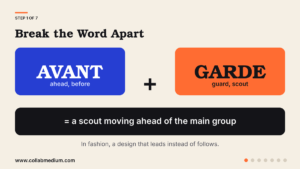
Start with the words themselves. “Avant” means before or ahead. “Garde” means guard. Together, they describe a scout moving ahead of the main group.
I keep this image in mind every time I judge a look. A true avant-garde design scouts new territory.
Step 2: Learn the Art Roots
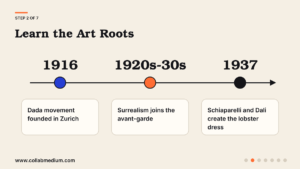
Fashion borrowed the idea from art. The Dada movement, founded in Zurich in 1916, helped shape avant-garde art, as Britannica notes. Surrealism followed in the 1920s and 1930s.
Fashion joined the conversation quickly. Designer Elsa Schiaparelli teamed up with Surrealist artist Salvador Dalí on a famous 1937 lobster dress. The Philadelphia Museum of Art holds the original. The FIT fashion history timeline explains how the dress shows the link between fashion and art.
Step 3: Study Real Examples
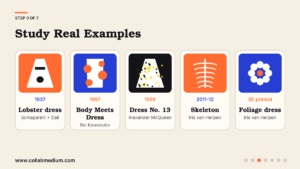
Examples teach faster than definitions. This table shows five looks that fit the meaning.
| Look | Designer | Why it counts as avant-garde |
| Lobster dress (1937) | Elsa Schiaparelli with Salvador Dalí | Fashion turned into a Surrealist art object |
| Dress No. 13 (spring/summer 1999) | Alexander McQueen | Robots spray-painted a white dress on the runway |
| Body Meets Dress, Dress Meets Body (spring/summer 1997) | Rei Kawakubo | Questioned where the body ends and clothing begins |
| Skeleton ensemble (fall/winter 2011-12) | Iris van Herpen | Used laser sintering instead of sewing |
| Foliage dress | Iris van Herpen | Took about 260 hours of continuous 3D printing |
The Met describes McQueen’s piece as a white cotton muslin dress that two robots spray-painted black and yellow, on its Savage Beauty blog. The V&A encyclopedia entry calls the moment a dance that turned predatory. The Foliage dress figures come from 3Dnatives.
Step 4: Spot the Six Signs of an Avant-Garde Look
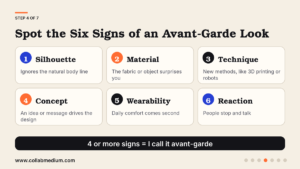
Use this quick checklist on any runway photo:
- Silhouette: The shape ignores the natural body line.
- Material: The fabric or object surprises you.
- Technique: The maker uses a new method, such as 3D printing or robots.
- Concept: An idea or message drives the design.
- Wearability: Daily comfort comes second.
- Reaction: The look makes people stop and talk.
If a look hits four or more signs, I call it avant-garde.
Step 5: Learn Why Designers Make It
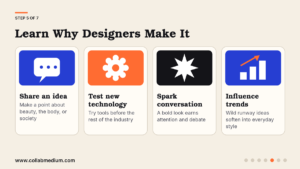
Many people ask why designers create clothes nobody can wear to the grocery store. I see four reasons:
- To share an idea: A garment can make a point about beauty, the body, or society.
- To test new technology: Designers try tools before the rest of the industry does.
- To spark conversation: A bold look earns attention and debate.
- To influence later trends: Wild runway ideas often soften into everyday styles.
Step 6: Tell It Apart from Similar Styles
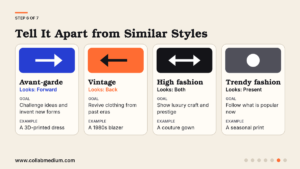
Avant-garde often gets mixed up with other styles. This table clears it up.
| Style | Looking forward or back? | Main goal | Example |
| Avant-garde | Forward | Challenge ideas and invent new forms | A 3D-printed dress |
| Vintage | Back | Revive clothing from past eras | A 1980s blazer |
| High fashion | Both | Show luxury craft and prestige | A couture gown |
| Trendy fashion | Present | Follow what is popular now | A seasonal print |
Vintage and avant-garde can overlap, because old pieces sometimes look bold today. If you love past decades, my 1980s vintage style guide and my 90s fashion women guide show how to wear them with confidence.
Step 7: Use the Meaning in Real Life
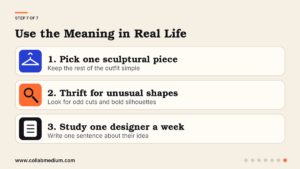
You do not need a runway budget. Start small:
- Pick one asymmetrical or sculptural piece and keep the rest simple.
- Thrift for unusual shapes. My unique vintage dress guide shows how to spot standout pieces.
- Study one designer each week and write one sentence about their idea.
If you want a full wearing guide, read my deeper article on what avant garde fashion is. It covers tools, shopping, and styling.
Common Mistakes to Avoid
I made most of these mistakes when I started:
- Calling every strange outfit avant-garde: Look for a real idea behind the design.
- Thinking it must be ugly: Avant-garde looks aim to be new, not unpleasant.
- Mixing it up with costume: A costume copies a character, while avant-garde invents a form.
- Ignoring history: The term makes more sense once you know the art roots.
- Judging from one photo: Read the designer’s story first.
Pro Tips from My Experience
- Ask what problem the designer tries to solve. That question unlocks most looks.
- Compare a runway piece with the wearable version in stores. You will see how ideas travel.
- Use museum websites for reliable background. They explain context better than social media.
- Keep a small notebook of looks that surprised you.
- Revisit a look after a month. Your opinion may change.
Final Thoughts
Now you know what avant garde means in fashion and how to spot it. It means bold, forward-looking design that treats clothing as an idea. Use the seven steps to read any runway look with confidence. For more style guides, explore the full fashion category on Collab Medium.
FAQs
What does avant garde mean in fashion?
In fashion, avant-garde means experimental clothing that pushes design ahead of its time. Designers use unusual shapes, materials, and ideas to challenge what clothing can be. The look often values concept over comfort.
What does avant garde mean in clothing?
In clothing, avant-garde describes garments with unconventional silhouettes, new materials, or bold concepts. Examples include a 3D-printed dress, a sculptural jacket, or a runway piece sprayed with paint.
What is the origin of the word avant-garde?
The word comes from French and means “advance guard” or “vanguard.” It first described the part of an army that moves ahead of the rest. Artists later used it for people who lead new ideas, and fashion followed.
What is the difference between avant-garde and vintage fashion?
Avant-garde looks forward and invents new forms. Vintage looks back and revives clothing from earlier decades. Some vintage pieces look bold today, but the goals differ.
Who are famous avant-garde fashion designers?
Rei Kawakubo of Comme des Garçons, Iris van Herpen, Alexander McQueen, and Elsa Schiaparelli lead many lists. Each designer pushed fashion toward art through unusual materials, techniques, or ideas.
Sources and External Links
I used these high-authority sources for the definitions, dates, and examples in this guide:
- Tate: Avant-garde (art term)
- Britannica Dictionary: Avant-garde
- Dictionary.com: Avant-garde
- Britannica: Avant-garde art
- The Met: Rei Kawakubo / Comme des Garçons press release
- The Met: Skeleton dress essay
- The Met: Dress, No. 13 (Alexander McQueen: Savage Beauty)
- V&A: Encyclopedia of Collections, No. 13
- Philadelphia Museum of Art: Evening Dress with Lobster Print
- FIT: 1937 Elsa Schiaparelli lobster dress
- 3Dnatives: Iris van Herpen at the Brooklyn Museum