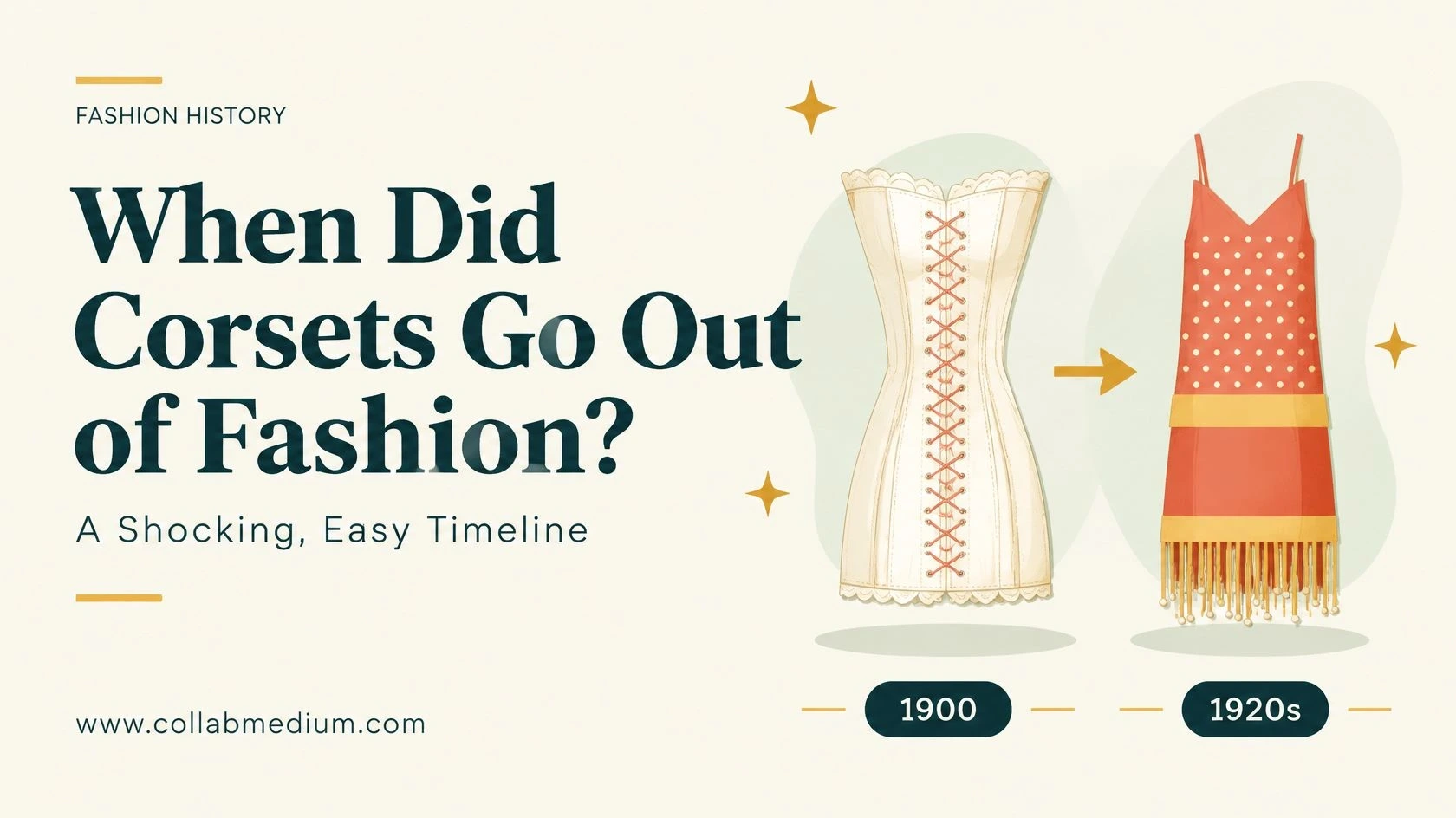
When did corsets go out of fashion? Most women stopped wearing everyday corsets between 1906 and the early 1920s. Designer Paul Poiret started the shift, World War I sped it up, and the flapper dress finished the job.
I used to think someone simply flipped a switch and corsets vanished. The real story is messier. Fashion, war, work, and new underwear all played a part.
In this guide, I walk you through seven easy steps. You will learn the key dates, the real reasons, and the surprising comeback. You will also learn which popular myths to ignore.
Quick answer: Corsets faded from everyday wear between 1906 and the 1920s. They returned briefly in the 1940s and 1950s. Since the 1970s, they have come back as a fashion statement instead of a daily requirement.
When Did Corsets Go Out of Fashion? The Short Answer
The decline did not happen in one year. It unfolded in three waves:
- 1906: Poiret introduced loose, high-waist dresses that needed no corset.
- 1914 to 1918: The first modern bra and wartime metal rationing pushed women toward lighter underwear.
- The 1920s: Straight, boyish dresses made the old corset look outdated.
Corsets did not disappear completely. Girdles, long-line corsets, and structured underwear stayed in use for decades. The classic Victorian corset simply stopped being a daily necessity.
Why This History Matters: Real-World Proof
Corsets shaped women’s clothing for a very long time. History.com reports that corsets became the standard undergarment for middle and upper class women in much of Europe by 1500, according to its corset history article. The Met says Poiret freed women from the corset, which had shaped the female form for hundreds of years, in its Poiret publication notes.
The numbers from the war years stand out. NPR reported that the U.S. War Industries Board asked American women in 1917 to stop buying corsets, and the move freed up about 28,000 tons of steel, as its bra history report explains.
These facts show one thing. The corset’s decline mixed fashion, politics, and everyday life.
Step-by-Step: How to Trace the Corset’s Decline
I use this seven-step method when I research any fashion history topic. It keeps the dates straight and the myths out.
Step 1: Start at the Peak (Around 1900)
Begin with the corset at its strongest. The Met explains that the S-curve shape of 1900 came from a straight-front corset. That corset pushed the bust forward and the hips back, in its twentieth-century silhouette essay.
This moment explains why people ask, when did corsets go out of fashion? The shape had become extreme, and a reaction was almost certain.
Step 2: Meet Paul Poiret (1903 to 1906)
Paris designer Paul Poiret led the first big break. The Associated Press reported that he abandoned the petticoat in 1903 and the corset in 1906, as CBS News published. His new dresses hung loosely from the shoulders and skipped the waist cinch.
Poiret loved the credit. In his 1931 autobiography, he claimed he freed women from the corset. Historians push back on that bold claim. They point to many cultural shifts that happened at the same time.
Step 3: Add the Bra (1914)
Undergarments changed too. American socialite Mary Phelps Jacob, later known as Caresse Crosby, patented her “backless brassiere” on November 3, 1914. She sewed it from two handkerchiefs and ribbon after a corset cover showed through her gown. She later sold the patent to the Warner Brothers Corset Company for $1,500, according to HISTORY.
The bra did not replace corsets overnight. It gave women a lighter option, and many chose it.
Step 4: Add World War I (1917 to 1918)
The war pushed the trend forward in two ways. First, corsets used metal stays, and the U.S. War Industries Board wanted that metal for the war effort. Second, women took on new jobs. HISTORY reports that about nine million women joined the American war effort in various roles.
Factory work and tight corsets did not mix. A woman in a munitions plant needed to bend, lift, and breathe.
Step 5: Look at the 1920s
The flapper era delivered the final blow. HISTORY quotes fashion historian Valerie Steele, who notes that women wore corsets and neck-to-ankle dresses in 1900. By the 1920s, hems rose to mid-calf, and many women wore bras and soft girdles instead.
The Met adds that the bandeau brassiere of the 1920s flattened the bust instead of supporting it. Some women with fuller curves still wore long-line corsets to fit the straight silhouette.
Step 6: Watch the Return (1930s to 1950s)
Structure came back quickly. The 1930s brought bias-cut gowns and tailored waists. In 1947, Dior’s New Look pulled the waist in again. The Met cites fashion historians Richard Martin and Harold Koda, who said the New Look needed the return of nineteenth-century style structure under the clothes.
So corsets did not truly vanish. They changed shape and name.
Step 7: Follow the Modern Revival (1970s to Today)
Designers later turned the corset into outerwear. Vivienne Westwood used corsets in her punk-inspired collections in the 1970s. Thierry Mugler and Jean Paul Gaultier followed in the 1980s. Madonna wore Gaultier’s cone-bust corset on her 1990 Blond Ambition tour, as V Magazine notes.
The trend kept growing. For Fall/Winter 2019, designers including Simone Rocha, Etro, Dion Lee, Sacai, and Burberry all showed corset looks, according to The Zoe Report. Kim Kardashian wore a Mugler corset gown to the 2019 Met Gala, and she said she took corset breathing lessons first, as Grazia reported.
Corset Decline Timeline at a Glance
This table sums up the key moments.
| Year | Event | Effect on corsets |
| Around 1500 | Corsets become standard for wealthy women in Europe | Long reign begins |
| 1900 | S-curve silhouette peaks | Extreme shaping |
| 1906 | Poiret drops the corset from his designs | Fashion breaks away |
| 1914 | Caresse Crosby patents the backless brassiere | Lighter alternative arrives |
| 1917 | War Industries Board asks women to stop buying corsets | Metal use drops |
| 1920s | Flapper dresses and bandeau bras dominate | Everyday corsets fade |
| 1947 | Dior’s New Look returns to a defined waist | Structure comes back |
| 1970s to today | Westwood, Gaultier, and Mugler revive the corset | Corset becomes fashion statement |
Corset vs. Bustier vs. Girdle: What Is the Difference?
These terms confuse many readers. This table clears them up.
| Garment | Main purpose | Typical structure | Modern use |
| Corset | Reshape the waist and torso | Boning and lacing | Fashion piece or costume |
| Bustier | Support the bust and show off the chest | Boning, often strapless | Top or evening wear |
| Girdle | Smooth the hips and thighs | Stretch fabric | Shapewear |
If you love vintage looks, my unique vintage dress guide shows how to find true period pieces. You can also compare the bold silhouettes in my 1980s vintage style guide and my 90s fashion women guide.
Common Mistakes and Myths to Avoid
I believed several of these myths myself:
- Thinking Poiret ended corsets alone: Many forces worked together.
- Thinking corsets vanished by 1910: Many women kept wearing them for years.
- Crediting only the war: Fashion, work, and new underwear mattered too.
- Mixing up corsets and girdles: They shape the body in different ways.
- Trusting one source: Compare museums, history sites, and news reports.
Pro Tips for Researching Fashion History
- Start with museum sources. The Met’s online Timeline of Art History explains each era clearly.
- Search digitized newspapers and magazines from the period. Ads reveal what women actually wore.
- Compare dates from at least two sources. Historians often disagree on exact years.
- Visit museum costume collections when you can. Real garments show how boned fabric moves.
- Keep a simple timeline in a notebook. I add one line per source.
Final Thoughts
Now you can answer when corsets go out of fashion with confidence. They faded between 1906 and the 1920s, returned in new forms, and became a bold style choice in the modern era. Use the seven steps whenever you research a fashion topic. For more style history, explore the full fashion category on Collab Medium.
FAQs
When did corsets go out of fashion?
Most women stopped wearing everyday corsets between 1906 and the early 1920s. Paul Poiret dropped the corset from his designs in 1906, World War I sped up the change, and 1920s flapper dresses made it look outdated.
Why did corsets go out of style?
Several things happened together. New loose dress shapes arrived, the modern bra appeared in 1914, and metal shortages hit during World War I. Women also took on active jobs that did not suit tight corsets.
What replaced corsets?
Bras, soft girdles, and later shapewear replaced everyday corsets. In the 1920s, the bandeau brassiere became popular. Longer corsets and girdles stayed in use for women who wanted extra shaping.
Did Paul Poiret really end corsets?
Poiret played a big role, but he did not act alone. He claimed sole credit in his 1931 autobiography, yet historians point to many cultural shifts, including war work and changing fashion ideals.
Are corsets in fashion today?
Yes, but as a style piece. Designers like Vivienne Westwood, Jean Paul Gaultier, and Thierry Mugler brought the corset back as outerwear. Many modern corsets focus on a natural shape instead of extreme cinching.
Sources and External Links
I used these high-authority sources for the dates, quotes, and facts in this guide:
- The Met: Twentieth-Century Fashion, Silhouette (Timeline of Art History)
- The Met Publications: Poiret
- CBS News (AP): The Man Who Liberated Fashion
- HISTORY: How World War I Helped Women Ditch the Corset
- NPR: Bra History, How a War Shortage Reshaped Modern Shapewear
- V Magazine: From Then ‘Til Now, History of the Corset
- The Zoe Report: The 2020s corset trend
- Grazia: The corset comeback