I have worked with dozens of dental practices across the US, and I see the same problem over and over. Talented dentists with premium offices and genuinely happy patients have almost no online presence. Their social media marketing sits dormant, their competitors are booking consultations directly from Instagram, and they cannot figure out why their schedule is not full. They know how to get clients through social media marketing for dentists.
The honest truth is that patients today research their dentist on social media before they ever pick up the phone. A practice that looks inactive online sends a quiet but powerful signal: this place is not worth my time. If you are ready to change that, this guide walks you through everything you need, step by step.
Why most dental practices struggle with social media
Most dentists did not go to school to become content creators. That is completely understandable. The problem is that social media for a dental practice is not optional anymore. It is where trust is built before a patient ever sits in your chair.
The three core problems I see most often are inconsistency, generic content, and no clear strategy. Practices post sporadically, share stock images that look nothing like their actual office, and have no idea which platforms are actually driving new patient inquiries. The result is wasted effort and zero measurable return.
The solution is not to post more. It is to post smarter, on the right platforms, with content that answers the specific questions your ideal patients are already asking online.
Choosing the right platforms for your practice
You do not need to be everywhere. Trying to maintain a presence on every platform at once is one of the fastest ways to burn out and abandon the strategy entirely. Pick two or three platforms based on where your target patients actually spend their time.
Best for before-and-after photos, team culture, Reels, and cosmetic dentistry showcases. Patients aged 25 to 44 are most active here.
Ideal for local community engagement, patient reviews, event announcements, and paid advertising to family demographics aged 35 and up.
TikTok
Powerful for reaching younger patients with short educational videos, myth-busting content, and behind-the-scenes practice tours.
YouTube
Best for longer procedure explainers, patient journey videos, and SEO-rich educational content that drives search traffic over time.
For most general dentistry practices in the US, I recommend starting with Instagram and Facebook. They share a unified ad platform through Meta Business Suite, which saves significant time and budget when you move into paid promotion.
What content actually works for dental practices
Before-and-after transformations
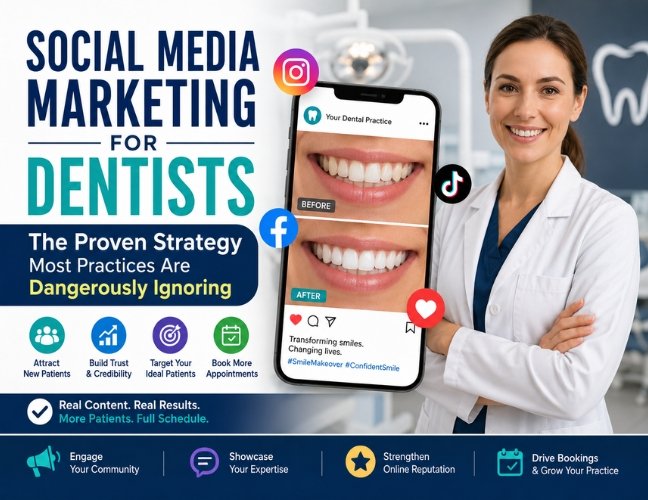
Nothing builds patient confidence faster than visual proof of results. Teeth whitening, Invisalign, veneers, and smile makeover transformations consistently generate the highest engagement of any content type for dental practices. Always get written consent before posting patient images, and always include HIPAA-compliant disclosure in your caption.
Real results from your actual patients outperform stock photos by a wide margin. Patients can tell the difference immediately, and authenticity is what drives action.
Educational content that reduces dental anxiety
Dental anxiety affects roughly 36 percent of Americans, according to research published by the American Dental Association. Content that demystifies procedures, explains what to expect during a root canal, or walks through a routine cleaning in a calm and clear way directly addresses one of the biggest barriers to booking. This type of content positions your practice as approachable, not just professional.
Team and culture content
Patients choose dentists they trust. Content that shows your actual team, their personalities, their training, and their day-to-day work creates the human connection that makes someone feel safe enough to call. A 30-second Reel of your hygienist explaining what happens during a new patient exam does more for bookings than five posts of generic dental tips ever will.
A practical content calendar for dental practices
| Day | Content type | Example idea | Best platform |
| Monday | Educational tip | “3 foods that secretly stain your teeth” | Instagram / FB |
| Tuesday | Team spotlight | 30-second intro video of a team member | Instagram Reels |
| Wednesday | Before and after | Smile transformation with patient consent | Instagram / FB |
| Thursday | FAQ post | “Does Invisalign hurt? Here is the real answer” | TikTok / Reels |
| Friday | Patient review highlight | Graphic featuring a 5-star Google review | Facebook / IG Story |
| Saturday | Behind the scenes | Office prep, sterilization process, team lunch | IG Story / TikTok |
You do not need to post every single day. Three to four times per week, done consistently, outperforms seven posts per week done sporadically. Consistency signals credibility to both the algorithm and your audience.
Tools and platforms that make dental social media manageable
Running social media marketing alongside a full patient schedule is genuinely difficult without the right tools. These platforms remove the friction and keep your strategy on track.
Buffer and Later are both strong choices for scheduling posts across Instagram, Facebook, and TikTok from a single dashboard. Buffer starts at $6 per month for individuals and scales for teams. Later offers a visual calendar that is especially useful for planning Instagram feeds with a consistent aesthetic.
Canva Pro is the most widely used design tool among dental practices for social media graphics. It offers a library of healthcare-specific templates, easy brand kit setup, and direct publishing integrations with most social platforms. At $15 per month, it pays for itself quickly when you compare it to outsourcing graphic design.
For reputation and review management, platforms like Birdeye and Podium help dental practices automatically request Google and Facebook reviews after appointments. According to Birdeye’s 2025 Healthcare Benchmark Report, practices using automated review requests see an average of 3.4 times more monthly reviews than those requesting them manually.
For paid social advertising, Meta Ads Manager gives dental practices precise geographic targeting, demographic filtering, and detailed performance analytics. A monthly budget of $300 to $600 in a local market can produce a measurable lift in new patient inquiries when the creative is well-executed.
Common mistakes dental practices make on social media
- Using only stock photography. Generic dental stock images make your practice look interchangeable with every other office in your city. Use real photos of your actual space, your team, and your work whenever possible.
- Posting without a call to action. Every post should tell the viewer what to do next: book a free consultation, click the link in bio, call today, or send a message. Posts without direction drive engagement but rarely drive appointments.
- Ignoring direct messages and comments. Unanswered DMs are lost patients. Responding to every comment and message within 24 hours is not optional if you want social media to actually drive revenue for your practice.
- Posting patient photos without written HIPAA consent. This is a legal compliance issue, not just an ethical one. Before posting any identifiable patient image, secure written release documentation. No exceptions.
- Treating all platforms the same. A 60-second TikTok format does not work on LinkedIn. A professional case study post does not belong on Instagram Stories. Tailor your content format and tone to each platform’s culture and audience expectations.
Paid social media marketing for dentists: when and how to use it
Start with organic, then amplify what already works
Many practices make the mistake of jumping straight into paid ads without first building any organic presence. Paid social amplifies content. It does not fix bad content. Spend your first 60 to 90 days building a library of real content and finding out what resonates with your audience organically. Then put budget behind what is already performing.
The best ad formats for dental practices
Lead generation ads on Facebook and Instagram allow potential patients to submit their name, phone number, and appointment request directly inside the platform without leaving to a website. These work especially well for high-value services like Invisalign consultations, implant inquiries, and teeth whitening promotions.
Video view campaigns build awareness at a low cost and are highly effective for practices entering new neighborhoods or competing with larger DSO brands in their local market. A well-produced 30-second video explaining your practice’s approach to patient comfort can run locally for as little as $10 to $15 per day.
Measuring results: what metrics actually matter
Vanity metrics like total followers and post likes feel good but do not pay for your office lease. The metrics that actually matter for a dental practice are reach growth, profile visits, link clicks, and most importantly, tracked inbound calls and form submissions that originate from social traffic.
Set up UTM parameters on any link you share in your bio or ad campaigns. This lets Google Analytics 4 tell you exactly how many website visits and appointment requests came directly from each social platform. Without this tracking, you are flying blind on ROI.
Review your analytics monthly, not daily. Social media results compound over time. A strategy that looks modest in month two often shows significant traction by month five when consistency has built both audience size and algorithmic momentum.
Frequently asked questions
What social media platforms are best for dental practices?
Instagram and Facebook are the most effective platforms for most dental practices, offering visual content tools, local ad targeting, and access to the 25-to-55 age demographic that books the majority of dental appointments. TikTok is a strong secondary choice for practices targeting younger patients.
How often should a dental practice post on social media?
Posting three to four times per week consistently outperforms daily posting done sporadically. Quality, relevance, and consistency matter far more than volume when building a social media presence for a dental practice.
How much should a dental practice spend on social media advertising?
Most small to mid-size dental practices see meaningful results with a monthly paid social budget of $300 to $800, focused on local Facebook and Instagram lead generation campaigns. High-value service promotions like implants or Invisalign typically justify higher monthly spend.
Can social media marketing actually bring in new dental patients?
Yes. Practices with active, consistent social media profiles attract significantly more new patient inquiries than those without an online presence, particularly through Facebook lead ads, Instagram before-and-after content, and patient review amplification campaigns.