
Every week, someone new asks me: “Is SEO even worth learning anymore?” With AI reshaping search results almost daily, I totally understand the confusion. But here is what I tell them every single time — SEO is not dying. It is evolving faster than ever.
If you are a beginner wondering where to start, or a skeptic questioning whether AI has made SEO irrelevant, this guide answers every question you have. We cover what SEO actually is, how to start from scratch, the 4 types and 4 pillars you need to understand, the jobs that survive AI, and whether you can realistically do this on your own.
What is SEO and how is it actually used?
SEO stands for Search Engine Optimization. It is the practice of improving your website so that search engines like Google, Bing, and Yahoo rank your pages higher in results. When someone types a question into Google, SEO determines whether your page shows up on page one or page fifteen.
Businesses use SEO to drive free, organic traffic to their websites. A law firm optimizes for “personal injury attorney in Chicago.” A food blogger targets “easy weeknight dinner recipes.” An e-commerce brand ranks for “best wireless headphones under $100.” The goal is always the same: show up when your audience is actively searching for what you offer.
SEO works across industries, business sizes, and content types. It is one of the most cost-effective long-term marketing strategies available today. Unlike paid ads that stop working the moment you stop paying, good SEO keeps generating traffic for months and even years.
Quick definition
SEO is the process of optimizing content, technical structure, and authority signals so search engines rank your pages higher and your audience finds you first.
The 4 types of SEO — broken down simply
Before you can start, you need to know what kind of optimization actually exists. There are four distinct types, and each one plays a different role in your overall strategy.
| Type | What it covers | Key tools | Difficulty level |
| On-Page SEO | Keywords, headings, meta tags, content quality, internal linking | Surfer SEO, Yoast, Clearscope | Beginner-friendly |
| Off-Page SEO | Backlinks, brand mentions, guest posting, social signals | Ahrefs, Moz, HARO | Intermediate |
| Technical SEO | Site speed, crawlability, schema markup, Core Web Vitals, XML sitemaps | Screaming Frog, Google Search Console | Advanced |
| Local SEO | Google Business Profile, local citations, reviews, location pages | BrightLocal, Whitespark | Beginner-friendly |
For most beginners, on-page SEO and local SEO are the best starting points. They deliver visible results without requiring deep technical knowledge.
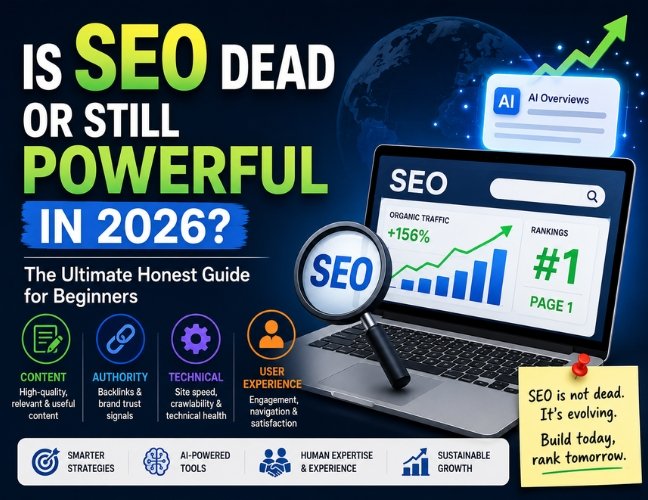
The 4 pillars of SEO every beginner must know
If the four types describe what SEO covers, the four pillars describe how it works. Think of these as the foundation of every successful SEO strategy.
Content
High-quality, relevant content that satisfies search intent and answers real user questions.
Authority
Backlinks and brand trust signals that tell Google your site is credible and worth ranking.
Technical health
Fast load times, clean site architecture, mobile-friendliness, and proper indexing signals.
User experience
Low bounce rates, clear navigation, and engagement signals that show users love your pages.
Google’s algorithm evaluates all four pillars simultaneously. You can write flawless content, but if your site loads in 8 seconds, your rankings will suffer. Balance is everything.
How to start SEO as a complete beginner
Step 1: understand keyword research first
Keyword research is the compass for everything else you do. Start by identifying what your target audience actually types into Google. Use Google Search Console (free), Ubersuggest (freemium), or Ahrefs (paid) to find keywords with solid search volume and manageable competition.
Focus on long-tail keywords to start. A phrase like “how to make cold brew coffee at home” is far easier to rank for than just “coffee.” Long-tail queries also attract more qualified visitors because they reveal clear intent.
Step 2: set up your technical foundation
Before writing a single word of content, make sure your site is technically sound. Install Google Search Console and Google Analytics 4. Both are free and both are essential. Submit an XML sitemap. Make sure your site loads under three seconds. Use PageSpeed Insights to identify performance issues.
If you are on WordPress, plugins like Rank Math or Yoast SEO handle most on-page optimization tasks without any coding knowledge. They guide you through adding meta titles, descriptions, and proper heading tags for every page.
Step 3: create content with search intent in mind
Search intent is the why behind a search query. Google classifies intent into four categories: informational (learning something), navigational (finding a site), commercial (comparing options), and transactional (buying something). Every piece of content you write should match the intent of its target keyword.
Pro tip from experience
Before writing any blog post, search for your target keyword in an incognito window and study the top 5 results. Note their word count, structure, and the subtopics they cover. Your content needs to be more thorough and better organized, not just longer.
Can you do SEO on your own?
Yes. Absolutely. I did it, and thousands of successful bloggers, small business owners, and content creators do it every single day. You do not need to hire an agency to get started.
The honest caveat is that DIY SEO works best for content-focused sites, small businesses, and niche websites where competition is moderate. If you are going head-to-head with enterprise brands and massive budgets in a highly competitive vertical, you will likely need professional support at some point.
For most small sites, the free tools available today, including Google Search Console, Google Analytics 4, and the free tiers of Ubersuggest and KeywordSurfer, give you everything you need to build a solid foundation. Invest 5 to 10 hours per week consistently, and you will see meaningful growth within 4 to 6 months.
Is SEO difficult to learn?
SEO has a learning curve, but it is not uniquely difficult. The fundamentals take a few weeks to absorb. Consistent application takes months to master. And the landscape itself evolves constantly, which means you never fully “finish” learning it.
The bigger challenge is patience. SEO results rarely arrive overnight. According to Ahrefs research, only 5.7 percent of newly published pages will rank in the top 10 results within a year. That number improves significantly with domain authority and content quality, but it illustrates why SEO requires a long-term mindset.
The best learning resources available today include Google’s official Search Central documentation, the Moz Beginner’s Guide to SEO, and Ahrefs’ free YouTube channel. All three are regularly updated and completely beginner-friendly.
Common mistakes beginners make in SEO
- Keyword stuffing content. Forcing a keyword into every paragraph signals low quality to Google and makes content unreadable for humans. Use keywords naturally and focus on topic depth instead.
- Ignoring search intent. Writing a product page when the query clearly wants a blog post, or vice versa, results in high bounce rates and poor rankings no matter how well-optimized your content is.
- Neglecting internal linking. Internal links pass authority through your site and help Google discover all your pages. Most beginners set up pages in isolation and miss this entirely.
- Chasing backlinks too early. Building links before your content is genuinely valuable wastes time and can attract spammy links that hurt more than they help.
- Not tracking results in Google Search Console. You cannot improve what you do not measure. Set up your Search Console account on day one and check it weekly.
AI in 2026?
This is the question everyone is asking right now, and the answer is more nuanced than most people expect. AI has absolutely changed SEO. It has not replaced it.
Google’s AI Overviews (formerly Search Generative Experience) now appear at the top of many search results and answer simple queries directly. This has reduced click-through rates on informational queries. According to Search Engine Land research published in early 2026, pages ranking in positions 1 through 3 saw a 15 to 30 percent drop in clicks when an AI Overview appeared above them.
But here is what that actually means for SEO professionals: the strategies that used to work for thin, informational content are now less effective. Original research, expert opinion, first-hand experience, and content that genuinely cannot be generated by AI are now more valuable than ever. Google’s E-E-A-T framework (Experience, Expertise, Authoritativeness, Trustworthiness) has become the new competitive moat.
Experience-based insight
In 2026, the smartest SEO professionals are not fighting AI. They are using tools like ChatGPT for research, Jasper for content drafting, and Semrush’s AI features for competitive analysis, while adding the human insight, real data, and brand voice that AI alone cannot replicate.
Which 3 SEO jobs will survive the AI shift?
The jobs in genuine danger are the ones built purely around producing volume: basic content writing, low-level link building outreach, and manual keyword list building. AI handles those tasks faster and cheaper now.
The roles that are not just surviving but thriving in 2026 are the ones that require human judgment, creative strategy, and relationship-building.
| Role | Why AI cannot replace it | Average US salary |
| SEO strategist | Business judgment, competitive positioning, client communication, and campaign strategy require human reasoning AI still lacks | $75K — $130K/yr |
| Technical SEO engineer | Diagnosing complex crawl issues, building schema markup systems, and optimizing Core Web Vitals requires deep technical problem-solving | $90K — $150K/yr |
| Digital PR and link strategist | Building real relationships with journalists, editors, and publishers requires human trust, pitch creativity, and authentic outreach | $65K — $110K/yr |
Is SEO dead or evolving in 2026?
SEO is not dead. It is the most meaningfully evolved it has ever been. The era of stuffing keywords and building spammy backlinks is long gone. What replaced it is a discipline that rewards genuine expertise, real user value, and authentic brand authority.
The brands winning in organic search right now are the ones that treat SEO as a long-term brand-building strategy rather than a traffic hack. Companies like HubSpot, NerdWallet, and Investopedia have built entire content ecosystems around topic authority. They dominate organic search not because of any one tactic, but because they have systematically built expertise, trust, and technical excellence over years.
If you start today with that same mindset, SEO still represents one of the highest-ROI digital marketing channels available. Organic search traffic does not come with a cost-per-click. Build it right, and it compounds over time in ways that paid advertising simply cannot match.
Frequently asked questions
What is SEO and how is it used?
SEO (Search Engine Optimization) is the process of improving your website’s content, structure, and authority so search engines rank it higher in results. Businesses use SEO to attract free, organic traffic from people actively searching for their products, services, or content.
Can I do SEO on my own as a beginner?
Yes, beginners can do SEO independently using free tools like Google Search Console, Google Analytics 4, and Ubersuggest. With consistent effort of 5 to 10 hours per week, most small sites begin to see meaningful organic growth within 4 to 6 months.
Is SEO replaced by AI in 2026?
AI has changed SEO significantly but has not replaced it. Google’s AI Overviews have reduced clicks on thin informational content, making original research, expert experience, and E-E-A-T signals more critical than ever for sustained organic rankings.
What are the 4 pillars of SEO?
The 4 pillars of SEO are content quality, domain authority (backlinks), technical health (site speed, crawlability), and user experience (engagement, navigation). All four pillars must work together for a website to rank consistently and sustain high search positions.