
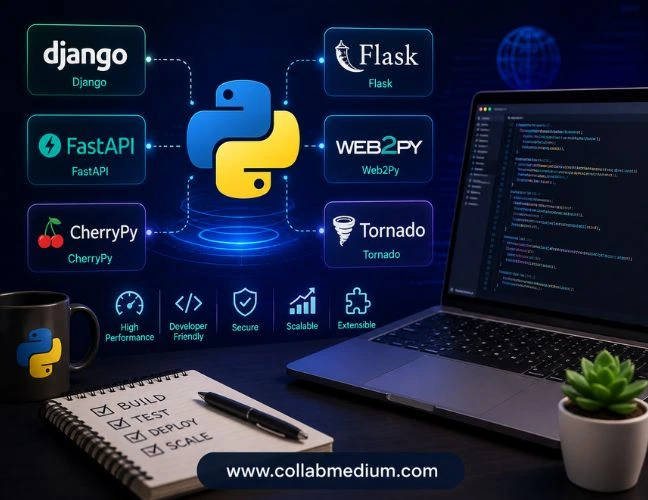
Picking a Python web framework feels simple at first. Then you start comparing options and the choices multiply fast. You want something that scales well. You also want something your team can actually learn quickly. That tension trips up more developers than you would expect.
I have spent years building applications and talking to developers about their stack choices. The same story repeats itself. Teams pick a framework because it is popular, not because it fits their project. They discover the mismatch months later, when refactoring costs real time and money.
This guide cuts through the noise. We will help you understand what separates a great framework from one that will slow your team down. We will also help you match the right Python web framework to your actual project needs.
Why the Python Web Framework Conversation Matters More Than Ever
Python has become one of the most in-demand skills in tech. It regularly ranks as a top programming language on major industry surveys, and that popularity feeds directly into framework adoption. When more developers write Python, more teams need a solid Python framework to ship real products.
Web development has also changed shape. Modern applications need to handle APIs, real-time data, and increasingly, machine learning features baked directly into the product. A framework built for the 2015 era of web development frameworks does not always meet 2026 demands.
The result: Developers now have excellent frameworks to choose from, each with real strengths. But that also means more chances to pick the wrong one for the job.
What Developers Actually Want From a Python Web Framework
Most development teams rank these priorities when evaluating a new stack.
Performance: A modern framework should handle concurrent requests without buckling under load.
Ecosystem and libraries: Rich package support saves weeks of custom development work.
Learning curve: New team members should get productive fast, not spend a month reading documentation.
Data science compatibility: Many teams now want their web layer to talk directly to data science and machine learning pipelines.
Community support: Active communities mean faster bug fixes and better long-term maintenance.
The Core Problem: Most Developers Choose the Wrong Framework
Here is the mistake I see constantly. A developer reads one blog post ranking the best framework for 2065 and picks the top result. They start building without asking whether that framework actually fits their project’s scale or purpose.
Months later, reality sets in. The lightweight framework they chose cannot handle the traffic. Or the full-featured framework they picked feels like overkill for a small internal tool. Refactoring a live application to a different framework is expensive and slow.
The average mid-sized web app now takes 300 to 600 developer hours to build well. Choosing the wrong foundation early can double that number through rework and technical debt.
How to Avoid the Most Common Mistakes
Start with your actual use case. Are you building a content-heavy site with an admin panel? A lightweight API for a mobile app? A data-heavy dashboard tied to machine learning models? Your answer should drive your shortlist.
Do not skip the proof-of-concept phase. Building a full app on assumptions alone is risky. Spin up a small prototype first. Test how the framework handles your expected traffic. Load test with realistic data. That real-world experience matters more than any benchmark chart.
Also research the long-term ecosystem. Package support, hosting compatibility, and community size vary widely across web development frameworks. A framework with a shrinking community can leave your team stuck later.
Top Python Web Framework Options Worth Considering in 2026
Here is a look at the best framework options across different project types. This comparison table breaks down the key strengths and ideal use cases.
| Framework | Type | Best For | Learning Curve | Data Science Fit |
| Django | Full-stack | Content sites, admin-heavy apps | Moderate | Good |
| Flask | Microframework | APIs, small to mid-size apps | Easy | Good |
| FastAPI | Async API framework | High-performance APIs, ML services | Moderate | Excellent |
| Pyramid | Flexible full-stack | Enterprise apps needing flexibility | Moderate to hard | Fair |
| Tornado | Async framework | Real-time apps, websockets | Hard | Fair |
| Bottle | Microframework | Tiny apps, prototypes | Very easy | Fair |
Framework strengths vary by project scope. Always test with a prototype before committing.
Django: The Powerhouse Web Development Framework
The Django Python framework remains a top choice for teams building content-heavy applications. So what is Django, exactly? It is a full-stack Python web framework that ships with an admin panel, an ORM, authentication, and security defaults built in from day one.
Django shines when your project needs structure fast. Its “batteries included” philosophy means less time wiring up basic features. Companies like Instagram and Spotify have relied on Django to scale massive user bases without rebuilding their core web development framework from scratch.
The tradeoff is flexibility. Django has opinions about how your project should be organized. Teams that fight those conventions often end up frustrated. Teams that embrace them ship faster.
Flask: Lightweight and Flexible
If you want a minimal, lightweight framework that gets out of your way, Flask remains a favorite. It gives you routing and templating, then lets you choose everything else. That flexibility makes it a strong pick for smaller APIs and services.
Flask’s simplicity is also its biggest strength for teams learning web development for the first time. The documentation is clear, and the community has built extensions for nearly every common need.
FastAPI: Built for Data Science and Machine Learning Workloads
FastAPI has grown rapidly because it solves a real problem. Teams building data science and machine learning services need speed and clean data validation. FastAPI delivers both, using Python type hints to generate automatic documentation and request validation.
Benchmarks from TechEmpower consistently show FastAPI outperforming Flask and Django in raw request throughput, thanks to its async foundation built on Starlette. For teams serving machine learning models through an API, this Python web framework has become the default recommendation.
Features That Actually Matter in a Web Framework
Marketing blog posts make every feature sound essential. Here is what actually makes a measurable difference once you are building real applications.
Scalability and Performance Under Real Load
A Python web framework that performs well in a demo does not always perform well at scale. Async support, like what FastAPI and Tornado offer, matters significantly once you are handling thousands of concurrent connections. Django and Flask can scale too, but usually need additional tooling like Celery or Gunicorn tuning.
Data Science and Machine Learning Integration
More products now need to serve predictions or run analysis directly through the web layer. A framework with strong data science compatibility saves significant integration time. FastAPI in particular pairs naturally with libraries like pandas, scikit-learn, and PyTorch, since the whole stack shares the same language.
Security Defaults Are Non-Negotiable
According to the OWASP Foundation, injection flaws and broken authentication remain among the most common web application vulnerabilities. A framework with strong security defaults, like Django’s built-in CSRF and SQL injection protections, removes an entire category of risk before you write a single line of custom code.
Common Mistakes to Avoid When Choosing a Python Web Framework
Mistake 1: Picking a framework based on hype alone. Trending GitHub stars do not guarantee the right fit for your project’s actual requirements.
Mistake 2: Ignoring your team’s existing skills. Switching your whole team to an unfamiliar framework has a real productivity cost during the first few months.
Mistake 3: Over-engineering a simple project. Not every internal tool needs an async, high-throughput framework. Sometimes Flask or Bottle is genuinely the better call.
Mistake 4: Underestimating deployment complexity. Some frameworks need more infrastructure knowledge to deploy correctly. Factor that learning curve into your timeline.
Pro Tips From Years of Building With Python Web Frameworks
Tip 1: Prototype before you commit. Build a small proof-of-concept in two or three frameworks before locking in your final choice. A weekend of testing saves months of regret.
Tip 2: Read the framework’s own documentation first. Skip the outdated blog posts. Official docs for Django, Flask, and FastAPI are well maintained and updated constantly.
Tip 3: Check the release cadence. A framework with frequent releases and active maintainers is safer long-term than one that has gone quiet for a year.
Tip 4: Plan your data layer early. Whether you pick an ORM like Django’s built-in system or SQL Alchemy with Flask, your data model choices shape the rest of your architecture.
Tip 5: Consider hiring and hosting availability. A popular framework makes it easier to hire developers and find hosting guides when something breaks at 2 a.m.
Machine Learning and Data Science Are Reshaping Framework Choices
The line between traditional web development and machine learning products keeps blurring. More companies want to serve models directly through their web framework rather than maintaining a separate service layer.
This shift has pushed Fast API adoption higher among data science teams specifically. Its async request handling processes model inference calls efficiently, even under heavy traffic. Django and Flask remain excellent choices too, especially when a project blends content management with lighter data science features rather than heavy model serving.
Teams building recommendation engines, chatbots, or predictive dashboards increasingly ask the same question early in planning. Which framework will keep pace as our data science needs grow? That question deserves real consideration before any code gets written.
Frequently Asked Questions
What is the best Python web framework for beginners?
Flask is widely considered the best framework for beginners. Its minimal setup and clear documentation help new developers understand core concepts fast. Django is a strong second option once you are ready for more built-in structure.
Is Django or Flask better for data science projects?
Flask and Django both work for data science projects, but FastAPI is generally the stronger pick. FastAPI’s async support and automatic validation handle machine learning inference requests more efficiently than either alternative.
What is Django used for?
Django is a full-stack Python web framework used for building content-heavy websites, admin dashboards, and large-scale applications. It includes built-in authentication, an ORM, and strong security defaults out of the box.
Do I need to learn a Python web framework for machine learning?
You do not need one to build machine learning models, but you typically need one to serve those models through an API. FastAPI has become the most common Python web framework choice for this purpose.