

Most people assume marriage only counts if there’s a ceremony, a license, and a signed document. But that’s not always true. In the United States, certain states legally recognize relationships as marriages even without any of that paperwork — and millions of couples have no idea they may already be legally married.
That gap in knowledge can have serious consequences. It affects property rights, inheritance, health insurance, taxes, and divorce proceedings. Understanding common law marriage is not just useful — it is essential for anyone in a long-term relationship who has never formally tied the knot.
This guide breaks down everything clearly, including which states have common law marriage, how it works, and what mistakes could cost you dearly.
What Is Common Law Marriage?
Common law marriage is a legally recognized union between two people who live together and present themselves as a married couple — without ever going through a formal marriage ceremony or obtaining a marriage license.
It is not simply “living together for seven years,” as the popular myth goes. That timeline is not a legal standard in any U.S. state. The actual requirements vary by state, but they generally share a few core elements.
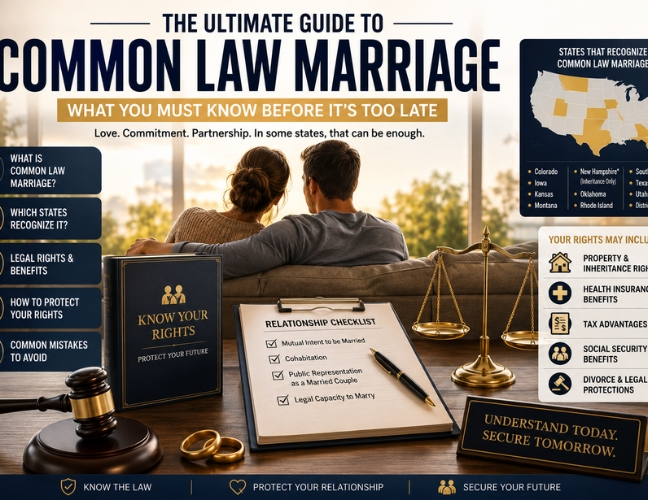
To establish a valid common law marriage, most states require:
- Both partners must be legally eligible to marry (of legal age, not already married to someone else)
- Both must mutually agree and intend to be married
- Both must live together (cohabitation)
- Both must hold themselves out publicly as a married couple (using the same last name, filing joint taxes, introducing each other as spouses)
Meeting all these criteria matters. Checking only a couple of boxes typically does not create a legally recognized union.
Which States Have Common Law Marriage?
This is the question most people search for first — and the answer is more nuanced than a simple list. As of 2025, the following states fully recognize common law marriage formed within their borders:
| State | Notes |
| Colorado | Recognizes if both parties are 18+ |
| Iowa | Must meet all standard requirements |
| Kansas | Requires clear intent and cohabitation |
| Montana | Recognized under state case law |
| New Hampshire | Only for inheritance purposes after death |
| Oklahoma | Recognized with full legal rights |
| Rhode Island | Recognized under common law precedent |
| South Carolina | Recognizes with intent and cohabitation |
| Texas | Referred to as “informal marriage” under state law |
| Utah | Requires court or agency validation |
| District of Columbia | Fully recognized |
Several other states like Georgia, Idaho, Ohio, and Pennsylvania used to recognize common law marriage but have since abolished it for new unions. However, those states still honor relationships that were established before the law changed. This is a critical distinction many couples overlook.
The state you live in now matters. But the state where your relationship was formed may matter just as much.
Why This Topic Confuses So Many People
The confusion around common law marriage is widespread — and understandable. Every state has its own rules. The legal definitions are vague. And pop culture has planted the “seven-year rule” so deeply in public consciousness that many people believe it as fact.
A 2019 survey by the American Family Survey found that nearly 40% of American adults incorrectly believe cohabitation alone is enough to trigger a common law marriage. That misunderstanding creates real legal vulnerability for couples who think they are protected when they are not — and for couples who have no idea they may already have legal obligations to each other.
Beyond confusion, there is also a practical problem. Couples in long-term relationships often have deeply intertwined finances, shared property, children, and debt. Without understanding their legal status, they cannot make informed decisions about protections, benefits, or even separation.
Legal Rights That Depend on Marital Status
Whether or not a common law marriage is recognized directly affects several major life areas.
Property and Inheritance
In most U.S. states, a surviving partner has no automatic right to the deceased partner’s estate without a will — unless they are legally recognized as a spouse. A 2021 AARP report found that over 60% of Americans do not have a will. For unmarried couples in non-recognition states, this creates serious financial risk when a partner dies.
Health Insurance and Benefits
Most employer health insurance plans extend spousal benefits to legal spouses only. In states that recognize common law marriage, partners may qualify for coverage. In states that do not, they are typically excluded regardless of how long they have been together.
Taxes
Legally married couples can file joint federal tax returns, which often results in a lower tax burden. Common law spouses in recognized states can do the same. The IRS does recognize common law marriages from states where they are valid. Couples who qualify and do not file jointly may be leaving real money on the table.
Social Security Benefits
A surviving spouse may be entitled to Social Security survivor benefits if the marriage is legally recognized. The Social Security Administration evaluates claims based on state law where the couple lived. This is one area where the stakes are especially high for older couples in long-term relationships.
How to Establish and Protect a Common Law Marriage
If you live in a state that recognizes common law marriage and believe your relationship qualifies, documentation is your most powerful tool.
Here are practical steps to take:
Gather Evidence of Intent and Cohabitation
Save documents that demonstrate shared life and mutual intent. These include:
- Joint lease or mortgage agreements
- Joint bank account statements
- Tax returns filed jointly
- Insurance policies listing each other as spouses
- Affidavits from family and friends acknowledging the relationship as a marriage
File a Declaration of Informal Marriage in Texas
If you live in Texas, the state allows couples to file a “Declaration of Informal Marriage” with the county clerk’s office. This creates an official record and removes any legal ambiguity. I strongly recommend this step for any Texas couple who meets the requirements.
Consult a Family Law Attorney
Laws vary significantly by state and can change. A licensed family law attorney can assess your specific situation, help you understand your rights, and recommend whether formalizing the relationship through a legal ceremony makes more sense. Resources like Avvo, LegalZoom, and FindLaw can help you locate attorneys in your state who specialize in family law.
Consider a Cohabitation Agreement
Even if you do not qualify for or want common law marriage status, a cohabitation agreement is a smart legal tool. It functions similarly to a prenuptial agreement, outlining property ownership, financial responsibilities, and what happens if the relationship ends. Platforms like LegalZoom and Rocket Lawyer offer template-based agreements you can customize and have reviewed by a licensed attorney.
What Happens When You Move States?
This is one of the most overlooked issues in this space. If you form a valid common law marriage in Texas and then move to Florida — a state that does not recognize common law marriage — your marriage remains valid.
Under the Full Faith and Credit Clause of the U.S. Constitution, states are generally required to honor legal marriages formed in other states. So a common law marriage that was validly established elsewhere travels with you.
But proving that status in a new state can require documentation and sometimes court action. This is another reason why paper trails and formal declarations matter so much.
Common Mistakes to Avoid
Many couples make these errors — often without realizing the consequences until it is too late.
Assuming cohabitation alone creates legal protection. It does not. Living together for any length of time, in any state, without meeting the other legal requirements does not create a common law marriage.
Ignoring the state-specific rules. Couples often assume the rules are the same everywhere. They are not. What qualifies in Colorado may not work in Kansas, and states that abolished common law marriage still have different cutoff dates.
Failing to document the relationship. Intent and cohabitation need to be demonstrable. Verbal agreements and private understandings carry little legal weight when disputes arise in court.
Not updating estate planning documents. Even in recognized states, a common law spouse should be named explicitly in a will, as a beneficiary on retirement accounts, and in any advance healthcare directives. Do not assume recognition alone is enough.
Skipping legal advice before separating. If a common law marriage exists and is recognized, ending the relationship legally requires a formal divorce — just like any other marriage. Walking away without legal separation can create complications around property, debt, and future marriages.
Pro Tips From Experience
A few insights that make a real difference when navigating this topic:
Keep a dedicated folder of relationship documents — both physical and digital. Include lease agreements, joint account statements, holiday cards addressed to you as a couple, and anything else that demonstrates your shared life. This evidence becomes crucial if your status is ever challenged.
Check your state’s laws every few years. Laws on common law marriage have changed in multiple states over the past two decades. What was true when you started your relationship may not be true today.
If you travel or relocate frequently for work, talk to a family law attorney proactively. Multi-state situations add a layer of complexity that is much easier to manage before a dispute arises.
Never rely on online tools alone for legal decisions. Platforms like LegalZoom and Rocket Lawyer are excellent starting points, but they do not replace personalized legal advice — especially in a topic as state-specific as this one.
Frequently Asked Questions
What is the difference between common law marriage and cohabitation?
Cohabitation simply means two people live together, while common law marriage requires mutual intent to be married and public representation as a married couple. Cohabitation alone does not create any legal marital rights in any U.S. state.
Does common law marriage require living together for seven years?
No, the seven-year rule is a myth with no legal basis in any U.S. state. Common law marriage is based on mutual intent, cohabitation, and public representation as spouses, not on any specific length of time together.
Do you need a divorce to end a common law marriage?
Yes, if your common law marriage is legally recognized in your state, ending it requires a formal legal divorce. Simply separating or moving apart does not dissolve the legal marriage and its associated rights and obligations.
Can a common law marriage be recognized for Social Security benefits?
Yes, the Social Security Administration recognizes common law marriages that were validly formed in states where they are legal. You may need to provide supporting documentation such as joint tax returns, affidavits, or a court judgment confirming the marriage.