
I remember the first time a client asked me to explain paid search in plain terms. I froze for a second. The industry loves jargon. Acronyms fly around a room before anyone defines them. That confusion is exactly why beginners feel stuck before they even launch a campaign.
This guide breaks things down step by step. I will walk you through the basics, the tools, and the mistakes I see most often. By the end, you will understand how this channel fits into a broader strategy. You will know exactly where to start.
What Is Search Engine Marketing?
Search engine marketing is the practice of using paid ads to increase a website’s visibility. It raises rankings on search engine results pages. Most people know it through Google Ads. Microsoft Advertising also plays a role for many brands. You bid on keywords, write ad copy, and pay each time someone clicks your listing.
This differs from organic strategies. Paid placements appear instantly. You do not wait months for rankings to climb. That speed is the main reason small businesses turn to paid search when they need quick visibility.
What Is Search Engine Optimization?
Search engine optimization, or SEO, is the process of improving a website so it ranks naturally. You earn placement without paying for clicks. SEO and paid search often get confused, but they solve different problems. SEO builds long-term visibility. Paid ads deliver traffic right away.
Most successful brands run both strategies together. SEO lowers your cost per click over time. Paid campaigns fill the gap while your organic rankings grow. Neither approach replaces the other completely.
How Does Search Engine Marketing Work?
The process starts with keyword selection. You choose terms your customers actually search for. Then you set a budget and a bidding strategy. Google or Microsoft runs an auction each time someone searches that term.
Your ad rank depends on your bid amount and your quality score. Quality score reflects how relevant your ad and landing page are to the search query. A high quality score often lowers your cost per click, even against competitors who bid more.
Once your ad goes live, you track clicks, conversions, and return on ad spend. Data drives every decision after launch. You pause weak keywords. You increase the budget on strong performers. That constant refinement is what separates profitable campaigns from wasted budgets.
SEM and Content Marketing
What Is Content Marketing?
Content marketing means creating useful articles, videos, or guides that attract an audience over time. It builds trust before someone ever considers buying. A blog post that answers a real question earns attention naturally.
Where the Two Strategies Overlap
Strong content actually improves your paid campaigns too. Landing pages built from solid content marketing convert better. They match search intent, which lifts your quality score and lowers your cost per click. Want a full framework for combining these channels? This guide to building a digital marketing strategy walks through the planning process.
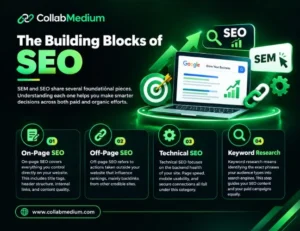
The Building Blocks of SEO
SEM and SEO share several foundational pieces. Understanding each one helps you make smarter decisions across both paid and organic efforts.
On-Page SEO
On-page SEO covers everything you control directly on your website. This includes title tags, header structure, internal links, and content quality. Clear, well-organized pages help both search engines and paid landing pages perform better.
Off-Page SEO
Off-page SEO refers to actions taken outside your website that influence rankings, mainly backlinks from other credible sites. A strong backlink profile signals trust to search engines. This detailed breakdown of off-page SEO covers link building tactics beginners often overlook.
Technical SEO
Technical SEO focuses on the backend health of your site. Page speed, mobile usability, and secure connections all fall under this category. A slow site hurts both organic rankings and paid landing page quality scores.
Keyword Research
Keyword research means identifying the exact phrases your audience types into search engines. This step guides your SEO content and your paid campaigns equally. Tools like Google Keyword Planner and Ahrefs reveal search volume and competition levels before you spend a dollar.
SEM vs SEO: A Side-by-Side Comparison
The table below breaks down how these two approaches compare on cost, speed, and effort.
| Factor | Paid Search (SEM) | Organic Search (SEO) |
| Time to Results | Immediate, often same day | Three to six months typically |
| Cost Structure | Pay per click | Time and content investment |
| Longevity | Traffic stops when budget stops | Rankings can last for years |
| Control Level | Full control over placement | Influenced, not guaranteed |
| Best Use Case | New launches, promotions, testing | Long-term brand authority |
Tools That Make This Work Easier
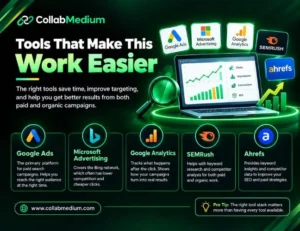
Google Ads remains the primary platform for paid search campaigns. Microsoft Advertising covers the Bing network, which often has lower competition and cheaper clicks. Google Analytics tracks what happens after the click. SEMrush and Ahrefs help with keyword research and competitor analysis for both paid and organic work.
Picking the right stack matters more than picking every available tool. This roundup of the best digital marketing tools breaks down which platforms actually earn their subscription cost.
According to average return on ad spend benchmarks, businesses typically earn about two dollars for every dollar spent on Google Ads. That figure varies by industry. Treat it as a starting benchmark, not a guarantee.
Common Mistakes Beginners Make
I have audited dozens of struggling accounts over the years. The same five issues show up again and again.
Ignoring negative keywords. Skipping this step wastes budget on searches that will never convert.
Sending traffic to a generic homepage. Dedicated landing pages convert far better than a busy homepage ever will.
Setting a budget and forgetting it. Campaigns need weekly attention, especially in the first month.
Chasing broad match terms only. Broad matches can bring irrelevant clicks without careful monitoring.
Ignoring mobile experience. Most searches now happen on phones, so a clunky mobile landing page kills conversions fast.
Pro Tips for Getting Started
These habits separate beginners who waste budget from those who scale profitably.
Start with a small daily budget. Test messaging and keywords before scaling aggressively.
Write three ad variations per group. Testing copy early reveals what resonates with your audience.
Track conversions from day one. You cannot optimize what you do not measure.
Review search terms weekly. This reveals which queries trigger your ads and where to add negative keywords.
Match ad copy to landing page content. Consistency between the two lifts your quality score and your conversion rate.
Frequently Asked Questions
What is search engine marketing in simple terms?
Search engine marketing means paying to show your website at the top of search results. You bid on keywords and pay only when someone clicks your ad.
Is SEO part of search engine marketing?
SEO and search engine marketing are related but separate. Many marketers use the term to describe paid search specifically, while SEO covers unpaid, organic rankings.
How much does search engine marketing cost for a small business?
Costs vary by industry and competition. Many small businesses start with a modest monthly budget and increase spend once campaigns prove profitable.
How long does it take to see results from search engine marketing?
Paid campaigns can show clicks and conversions within hours of launching. Meaningful, stable performance data usually takes two to four weeks to gather.