
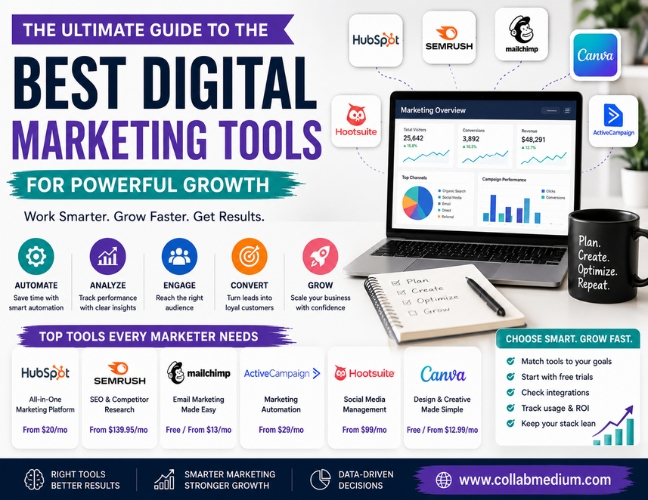
Choosing the right digital marketing tools feels harder than it should. New platforms launch every month. Every vendor promises to fix your funnel overnight. Most marketers end up with a messy stack that barely talks to itself.
I have built and audited marketing stacks for small businesses and large teams alike. The same pattern shows up constantly. People buy tools based on hype instead of fit. They stack up subscriptions and use a fraction of the features.
This guide clears up the confusion. We will walk through what actually separates great digital marketing tools from forgettable ones. You will also learn which platforms fit specific goals, budgets, and team sizes.
Why Digital Marketing Tools Matter More Than Ever
The marketing technology landscape has exploded. According to a chiefmartec.com industry scan, the number of martech products passed 14,000 in 2024. That growth makes smart tool selection essential, not optional.
Brands like HubSpot, Semrush, and Mailchimp built their reputations by solving real problems. Newer entrants like Surfer SEO and Jasper have carved out space by focusing on narrow, high-value tasks. The competition benefits marketers, but it also creates decision fatigue.
What Marketers Actually Want From Digital Marketing Tools
Most teams rank these priorities when evaluating new software.
Ease of use: A steep learning curve kills adoption fast.
Integration: Tools need to connect cleanly with your CRM and ad platforms.
Reporting clarity: Dashboards should answer questions, not create new ones.
Pricing transparency: Hidden tiers and per-seat surprises frustrate growing teams.
Support quality: Fast, knowledgeable support saves hours during launches.
The Core Problem: Most Marketers Choose Tools the Wrong Way
Here is the mistake I see constantly. A marketer reads one glowing review of a platform. They sign up for a paid plan the same afternoon. Three months later, half the features sit unused.
This happens because most buyers skip the discovery step. They do not map their actual workflow before shopping. They chase feature lists instead of solving a specific bottleneck.
The average mid-size company now spends thousands of dollars a month across its marketing stack. A Gartner survey found that marketing leaders allocate roughly 9.1% of company revenue to marketing budgets, with software representing a growing share. Wasted spend adds up fast when tools go unused.
How to Avoid the Most Common Mistakes
Start by mapping your workflow before you shop. List every stage from lead capture to conversion. Identify where the friction actually lives.
Do not skip the free trial. Thirty seconds of scrolling through a demo video tells you almost nothing. Load in real data. Ask your team to run one full campaign inside the trial account.
Also check integration compatibility early. A brilliant analytics tool that will not connect to your CRM creates more work, not less. Many teams find success referencing a broader content marketing agencies comparison before locking in a stack, since agencies often standardize on proven platforms.
Set a firm trial deadline too. Give your team two full weeks to stress test a new platform. Open-ended trials tend to drag on without a real decision. A deadline forces an honest evaluation of whether the tool solves the problem you identified.
Top Digital Marketing Tools Worth Considering in 2026
Here is a breakdown of standout digital marketing tools across common marketing needs.
| Tool | Best For | Standout Feature | Starting Price |
| HubSpot | All-in-one marketing | Unified CRM and automation | Free tier, paid from $20/mo |
| Semrush | SEO and competitor research | 26 billion keyword database | From $139.95/mo |
| Mailchimp | Email marketing on a budget | Drag-and-drop automation | Free tier, paid from $13/mo |
| ActiveCampaign | Advanced automation | Trigger-based workflows | From $29/mo |
| Hootsuite | Social media scheduling | Multi-platform publishing | From $99/mo |
| Canva | Design and creative assets | Templates for every channel | Free tier, paid from $12.99/mo |
HubSpot: The All-in-One Marketing Powerhouse
HubSpot remains a top pick for teams that want everything under one roof. The platform combines CRM, email automation, landing pages, and reporting in a single dashboard. Onboarding is smoother than most enterprise alternatives.
The free CRM tier makes HubSpot approachable for small teams. Growing companies can scale into paid Marketing Hub tiers without switching platforms entirely.
Semrush: The Best Tool for SEO and Competitive Research
If organic visibility drives your business, Semrush deserves serious attention. The platform tracks keyword rankings, backlink profiles, and competitor strategies in real time. Semrush reports that its database now covers over 26 billion keywords across 142 countries.
Agencies rely on Semrush for client reporting because the data holds up under scrutiny. The learning curve is real, but the payoff is worth the effort.
Mailchimp: Best Value for Email Marketing on a Budget
Mailchimp built its name on approachable email marketing. The drag-and-drop editor makes campaign creation fast, even for beginners. Automation workflows now rival more expensive platforms.
Small businesses appreciate the generous free tier. As lists grow, Mailchimp scales pricing predictably without forcing a full platform switch.
Features That Actually Matter in Digital Marketing Tools
Marketing materials make every feature sound essential. Here is what actually moves the needle in daily use.
Automation That Reduces Manual Work
The single biggest time saver in any stack is reliable automation. Tools like ActiveCampaign and HubSpot let you build trigger-based workflows that run without supervision. This frees your team to focus on strategy instead of repetitive tasks.
Reporting That Answers Real Questions
A dashboard full of vanity metrics wastes everyone’s time. Look for tools that connect campaign activity directly to revenue. Google Analytics 4 and Semrush both offer attribution views that tie spend to outcomes.
Integration Depth Across Your Stack
Your tools should talk to each other without manual exports. Zapier and native integrations solve most connection problems. Check integration lists before you commit to any new platform.
What Digital Marketing Tools Are Recommended?
The best tools for digital marketing depend on your specific goal. For all-in-one management, HubSpot leads the pack. For SEO and competitive research, Semrush stands out as the industry standard. For budget-conscious email marketing, Mailchimp remains a reliable choice.
Teams focused on paid social should evaluate Meta Ads Manager alongside a scheduling tool like Hootsuite or Buffer. Teams building organic traffic should pair Semrush with a solid content calendar and revisit strategies like link building outsourcing when backlink growth stalls.
Pro Tips From Years of Managing Marketing Stacks
Tip 1: Audit your stack every quarter. Cancel any tool your team has not logged into in 30 days.
Tip 2: Negotiate annual pricing. Most vendors offer 15 to 20 percent discounts for annual commitments over monthly billing.
Tip 3: Train one internal champion per tool. A single power user who knows every feature prevents wasted licenses.
Tip 4: Start with free tiers before upgrading. Tools like Mailchimp, Canva, and Google Analytics offer genuinely useful free versions.
Tip 5: Document your workflows. When a team member leaves, documented processes prevent knowledge gaps from stalling campaigns.
Tip 6: Watch for feature overlap. Many marketing suites now bundle SEO tracking, social scheduling, and email automation together. Paying twice for the same function drains the budget quietly over time.
Frequently Asked Questions
What digital marketing tools are recommended for beginners?
Beginners should start with HubSpot’s free CRM and Mailchimp for email campaigns. Both offer generous free tiers and simple onboarding for new marketers.
What are the best tools for digital marketing on a small budget?
Mailchimp, Canva, and Google Analytics deliver strong value at low or no cost. These tools cover email, design, and reporting without heavy investment.
How many digital marketing tools does a small business actually need?
Most small businesses need four to six core tools covering email, social scheduling, analytics, and SEO. Adding more often creates redundancy instead of value.
Are paid digital marketing tools worth the investment?
Paid digital marketing tools are worth it when they save measurable time or directly increase revenue. Track usage and ROI quarterly to confirm the investment pays off.