
Sending your child off to preschool feels like a big milestone. You want those hours to count. But most parents never get a clear answer about what actually happens inside the classroom.
I have spent years researching early childhood programs and talking with preschool teachers. The same question comes up constantly. Parents want to know what to learn in pre school. They also want to know how to support it at home. This guide breaks it down in plain terms.
Why Early Childhood Education Matters So Much
The first five years shape a child’s brain more than any other stage of life. Neural connections form faster during this window than at any later point. A strong preschool experience builds the foundation for everything that follows.
According to the CDC’s developmental milestones program, children reach measurable progress by age five. This progress shows up in how they play, speak, and move. Missing that window does not doom a child. But using it well gives real advantages.
Preschool is not just childcare. It is structured early childhood education designed around how young brains actually grow. Teachers plan activities around specific developmental goals, even when the day looks like simple play.
The Problem Most Parents Run Into
Many parents pick a preschool based on location or price alone. They never ask what the daily schedule teaches. Months later, they realize their child cannot recognize letters or struggles to share toys with classmates.
This happens because preschool goals are rarely explained clearly. Brochures use vague phrases like “whole child development” without breaking down real skills. Parents deserve specifics, not marketing language.
Look for programs with NAEYC accreditation or a state pre-K rating system. Free options through Head Start also follow strong developmental standards. These signals tell you far more than a glossy brochure ever will.
What Should a Child Learn in a Pre School Setting
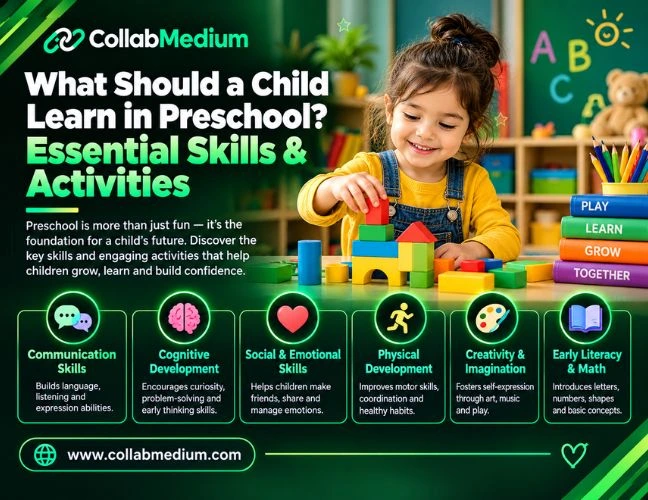
A quality program covers five core skill areas. Each one builds on the others throughout the school year.
Communication Skills and Early Language
Communication skills sit at the center of preschool learning. Children practice speaking in full sentences, following two-step directions, and asking questions. Teachers read aloud daily to build vocabulary and listening comprehension.
Storytelling time also introduces letter sounds and rhyming patterns. These pre-reading skills prepare children for kindergarten phonics lessons. A child who hears rich language daily typically enters kindergarten with a stronger vocabulary.
Language development does not stop at English alone. Many preschools now introduce basic words in a second language through songs and games. Bilingual households can benefit here too. Our guide on how to learn a new language has strategies worth adapting for young learners.
Early Math and Problem-Solving
Preschool math looks nothing like worksheets. Children count objects during snack time. They sort blocks by color and size. They compare which cup holds more water.
These activities build number sense before children ever see a written equation. Puzzles and shape-sorting toys strengthen spatial reasoning. Simple patterns, like red-blue-red-blue, teach early logic skills that support later math success.
Social Skills and Emotional Growth
Social work happens constantly in a preschool classroom, even though nobody labels it that way. Children learn to take turns, resolve small conflicts, and recognize feelings in themselves and others. Circle time activities teach group cooperation.
Emotional regulation gets direct attention too. Teachers name feelings out loud and model calm responses to frustration. A child who practices this early handles disappointment far better by kindergarten.
Fine and Gross Motor Skills
Cutting with safety scissors, holding a crayon correctly, and stringing beads build fine motor control. These small movements prepare little hands for writing. Gross motor skills grow through running, climbing, and balancing games during outdoor time.
Active outdoor play also introduces early safety awareness. Preschools that include splash pads or water tables should reinforce close supervision. Our water safety guide for families covers precautions worth discussing with any water-play program.
Independence and Self-Help Skills
Zipping a jacket, washing hands, and cleaning up toys teach independence. These tasks feel small but build confidence. Children who master self-help skills adjust to kindergarten routines with far less stress. Practicing these tasks at home reinforces what teachers work on during the school day.
Preschool Learning Milestones by Age
The table below outlines typical skills across the preschool years. Every child develops at a different pace, so treat these as general guideposts.
| Age | Language Skills | Cognitive Skills | Social Skills |
| 3 Years | Speaks in 3-4 word sentences | Sorts objects by shape | Plays alongside other kids |
| 4 Years | Tells simple stories | Counts to ten reliably | Shares with some prompting |
| 5 Years | Uses full sentences clearly | Recognizes letters and numbers | Cooperates in group games |
Common Mistakes Parents Make
Choosing a preschool based only on convenience. Location matters, but curriculum quality matters more for long-term outcomes.
Expecting academic drilling too early. Preschoolers learn best through play, not flashcards and worksheets.
Skipping teacher conversations. A quick daily chat with the teacher reveals more than any report card.
Ignoring social skill development. Parents often focus only on letters and numbers while social work gets overlooked.
Comparing children to classmates. Every child hits milestones on a different timeline, and comparison creates unnecessary pressure.
Pro Tips for Supporting Preschool Learning at Home
Tip 1: Read together every single day. Even fifteen minutes builds vocabulary and listening skills fast.
Tip 2: Narrate daily routines. Describing what you are doing while cooking or cleaning builds language naturally.
Tip 3: Let your child struggle a little. Small frustrations, like a stuck puzzle piece, build persistence and problem-solving.
Tip 4: Ask open-ended questions. Instead of yes or no questions, try “What happened at school today?”
Tip 5: Keep a consistent bedtime routine. Well-rested children focus better and manage emotions more easily during the school day.
How Preschool Teachers Build These Skills Through Play
Play is not a break from learning. It is the primary method preschool learning actually uses. Block building teaches engineering basics. Pretend kitchens teach sequencing and vocabulary. Dress-up corners build social scripts children use in real conversations.
The National Association for the Education of Young Children has long championed play-based learning. It considers this approach developmentally appropriate for this age group. Structured free play, guided by an attentive teacher, delivers more lasting growth than rigid drills.
Group projects, like building a class garden or a pretend grocery store, combine every skill area. Children practice language, math, and social work at the same time. They rarely realize they are learning at all.
Frequently Asked Questions
What should a child learn in a pre school program?
A child should learn communication skills, early math concepts, social skills, and fine motor coordination. Preschool also builds independence through self-help tasks like dressing and cleaning up.
What do kids learn in pre school besides academics?
Kids learn emotional regulation, sharing, following routines, and problem-solving. These social work skills often matter more for kindergarten readiness than early academics.
How does early childhood education support communication skills?
Early childhood education builds communication skills through daily reading, group discussion, and guided play. Teachers model full sentences and encourage children to express needs verbally instead of pointing or crying.
Is preschool learning necessary before kindergarten?
Preschool learning is not legally required. It does give children a head start on routines, social skills, and pre-reading concepts. Children without preschool experience can still succeed with strong support at home.