
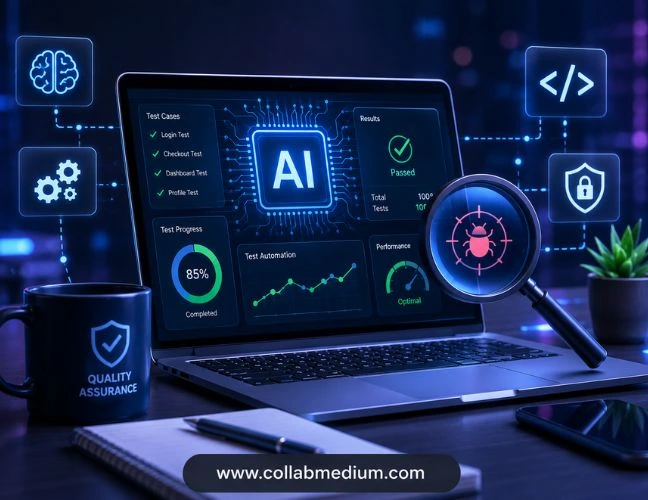
TL;DR: AI is reshaping software testing by making test creation, execution, and maintenance faster and more intelligent. Engineering teams that combine AI-powered testing with expert QA practices can reduce release cycles, improve software quality, and deliver better user experiences. Companies like Appsierra are helping businesses adopt these modern software testing services without disrupting their existing development workflows.
Every Faster Release Comes with a Bigger Risk
Three weeks before launching a new feature, the engineering team at a growing SaaS company was under pressure.
Developers had finished coding. Product managers had already announced the launch date. Marketing campaigns were scheduled.
Then reality struck.
Regression testing took nearly a week. Several automated scripts failed because of minor UI changes. Performance issues appeared under heavy traffic, and a security review uncovered vulnerabilities that could delay the entire release.
The problem wasn’t the development team.
It was an outdated testing strategy struggling to keep pace with modern software development.
This challenge is becoming common across industries. As release cycles get shorter and applications become more complex, traditional QA approaches alone are no longer enough. AI software testing is emerging as a practical solution that enables engineering teams to deliver faster releases without compromising quality.
Why Traditional Software Testing Is Reaching Its Limits
Modern applications are very different from the software products teams built just a few years ago.
Today’s engineering environments include:
- Continuous Integration and Continuous Deployment (CI/CD)
- Microservices architectures
- Cloud-native applications
- Multiple APIs
- Mobile and web platforms
- Frequent production releases
Testing every change manually is almost impossible.
Even conventional automation struggles because maintaining thousands of scripts consumes valuable engineering time.
As software complexity increases, organizations are looking beyond traditional automation and adopting software testing as a service model that provides scalable expertise, advanced tools, and faster execution.
How AI Is Changing Software Testing
Artificial Intelligence isn’t replacing QA engineers.
Instead, it helps them make smarter decisions while automating repetitive tasks.
Intelligent Test Generation
Instead of writing every test case manually, AI analyzes application behavior and user flows to generate meaningful test scenarios automatically.
This significantly reduces preparation time and improves overall test coverage.
Many organizations combine this approach with test automation as a service to scale testing across multiple products without increasing internal QA resources.
Self-Healing Test Automation
One of the biggest frustrations in automation is broken scripts.
A simple UI update can cause dozens of automated tests to fail.
AI-powered frameworks automatically identify these interface changes and update locators, reducing maintenance efforts and keeping automation reliable.
This is one reason businesses are increasingly investing in automated testing as a service for long-term efficiency.
Predictive Defect Analysis
AI studies historical defects, code changes, and testing patterns to predict where bugs are most likely to appear.
Instead of testing everything equally, engineering teams focus their attention on high-risk components.
The result is better software quality with fewer testing hours.
AI Is Expanding Beyond Functional Testing
Modern software quality goes far beyond verifying whether buttons work.
Engineering teams now integrate AI into multiple testing disciplines.
Performance Testing
AI can identify unusual response-time patterns before customers experience slow applications.
When combined with performance testing as a service, organizations can continuously monitor application behavior and optimize performance before every release.
Load Testing
Predictive analytics also improves load testing as a service by simulating realistic traffic conditions and identifying scalability issues before major launches.
Instead of reacting to system failures, businesses prevent them.
Security Testing
Cyber threats evolve constantly.
AI helps security teams prioritize vulnerabilities, analyze attack patterns, and improve security testing as a service initiatives.
Organizations also strengthen application resilience through application security testing as a service, ensuring security becomes part of the development lifecycle instead of a final checkpoint.
Mobile Testing
With users expecting seamless experiences across hundreds of devices, AI improves mobile testing as a service by identifying compatibility issues, UI inconsistencies, and device-specific bugs much faster than manual processes.
The Business Benefits of AI-Powered Software Testing
Engineering leaders aren’t adopting AI simply because it’s innovative.
They’re adopting it because it produces measurable business outcomes.
Some of the most significant advantages include:
- Faster release cycles
- Reduced regression testing time
- Higher automation coverage
- Improved software stability
- Lower testing costs
- Better customer satisfaction
- Earlier bug detection
- Increased engineering productivity
Many organizations now work with experienced Testing as a Service providers because they gain access to specialized expertise without expanding internal QA teams.
Common Mistakes Companies Make
Despite the excitement around AI, successful implementation requires strategy.
The most common mistakes include:
Expecting AI to Replace QA Engineers
AI supports testers—it doesn’t replace critical thinking, exploratory testing, or business understanding.
Poor Test Data
AI performs only as well as the data it receives.
Low-quality datasets produce unreliable results.
Ignoring Security
Many teams automate functional testing while overlooking pen testing as a service, leaving applications vulnerable despite successful releases.
Focusing Only on Automation
Automation alone doesn’t guarantee quality.
A balanced QA strategy combines functional, performance, security, usability, and exploratory testing.
Case Study: How Appsierra Helped Collabmedium Improve Release Quality
Imagine Collabmedium, a rapidly growing SaaS platform, preparing for international expansion.
Its engineering team faced several challenges:
- Regression testing required six days.
- Automation scripts frequently failed.
- Customer-reported bugs continued increasing.
- Application performance dropped during traffic spikes.
- Security reviews delayed production releases.
Appsierra evaluated the existing QA process and introduced a modern AI-assisted quality engineering strategy.
The solution included:
- AI-powered regression automation
- Smart test prioritization
- QA testing as a service
- Performance optimization
- Security assessments
- Mobile compatibility validation
- Continuous testing integrated into the CI/CD pipeline
Within four months, Chatbase achieved measurable improvements:
| Metric | Improvement |
| Regression testing time | Reduced by 60% |
| Production defects | Reduced by 68% |
| Release frequency | Increased by 50% |
| Performance issues | Reduced by 47% |
| Customer satisfaction | Improved significantly |
Rather than simply automating tests, Appsierra helped build a scalable quality engineering strategy that supported faster business growth.
How Engineering Leaders Can Prepare for AI Testing
Organizations planning to adopt AI-powered testing should focus on long-term quality rather than short-term automation.
A practical roadmap includes:
- Identify repetitive testing tasks.
- Integrate AI into existing automation frameworks.
- Prioritize high-risk business workflows.
- Invest in continuous performance and security testing.
- Measure business outcomes—not just automation percentages.
- Partner with experienced testing as a service company when specialized expertise is required.
AI works best when combined with experienced QA professionals who understand both technology and business objectives.
For more Technology related articles , please visit : https://collabmedium.com/category/technology/
Final Thoughts
Artificial Intelligence is transforming software testing from a reactive process into a proactive quality engineering practice. Engineering teams that embrace AI can release software faster, improve reliability, and reduce operational risks without sacrificing customer experience.
As organizations modernize their development pipelines, experienced partners like Appsierra help businesses combine AI-driven automation with practical quality engineering strategies that deliver measurable results.
The same commitment to software quality is essential for business applications across every industry—including recruitment technology. As an AI-powered recruitment software platform, Pitch N Hire relies on reliable performance, strong security, and continuous software testing to ensure recruiters and hiring teams can manage candidate sourcing, screening, and hiring efficiently. This highlights how robust software quality directly contributes to a faster, more seamless recruitment experience.
Frequently Asked Questions
1. What is AI software testing?
AI software testing uses machine learning and intelligent algorithms to automate test creation, maintenance, defect prediction, and test optimization, making software testing faster and more efficient.
2. Does AI replace software testers?
No. AI enhances the work of QA professionals by automating repetitive tasks, while human expertise remains essential for exploratory testing, business validation, and strategic decision-making.
3. What industries benefit most from AI-powered testing?
SaaS, fintech, healthcare, e-commerce, manufacturing, and HR technology companies benefit significantly because they release software frequently and manage complex applications.
4. How does AI improve automation testing?
AI creates smarter test cases, heals broken automation scripts, predicts defects, prioritizes high-risk tests, and reduces maintenance efforts.
5. Why is continuous testing important?
Continuous testing helps identify defects earlier, improves release confidence, and supports faster software delivery within Agile and DevOps environments.
6. When should a company consider Testing as a Service?
Organizations with limited internal QA resources, growing product portfolios, or aggressive release schedules often benefit from Testing as a Service because it provides scalable expertise and faster execution.