
Most website owners pour time and money into creating great content, fixing technical issues, and optimizing on-page elements. Then they wonder why their pages still sit on page three of Google. The missing piece is almost always the same thing: links.
Link building remains one of the most misunderstood and underinvested areas of SEO. Some people think it is outdated. Others try it briefly, get no results, and give up. And a surprising number of site owners have never done it intentionally at all.
That gap in strategy is costing them real traffic, real visibility, and real revenue. This guide covers exactly what link building is, why it matters more than ever, and the proven tactics that actually move the needle in today’s search landscape.
What Is SEO Link Building?
SEO link building is the process of acquiring hyperlinks from other websites that point back to your own. These incoming links are called backlinks. When a reputable website links to your content, it acts as a vote of confidence in your site’s authority and relevance.
Google has confirmed that backlinks are one of its top three ranking factors, alongside content quality and RankBrain. That has been consistent for over two decades. The algorithm has evolved significantly, but the core signal — other credible sites vouching for yours — has never lost its importance.
Not all links carry the same weight. A backlink from a high-authority domain like Forbes, HubSpot, or a major university carries exponentially more value than a link from a low-traffic directory site. Google evaluates the quality, relevance, and trustworthiness of the linking domain when determining how much credit to pass through.
Why Link Building Still Drives SEO Results in 2026
Some voices in the SEO community periodically declare link building “dead.” The data says otherwise.
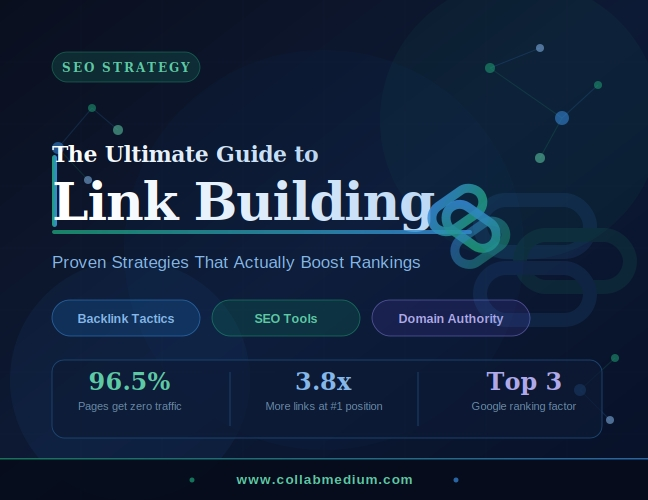
A 2023 study by Ahrefs analyzed over one billion web pages and found that a staggering 96.55% of all pages get zero organic traffic from Google. The number one differentiator between pages that rank and pages that do not? Backlinks. Pages ranking in the top three positions on Google carry significantly more referring domains than those ranking lower.
Backlinko’s analysis of 11.8 million Google search results confirmed that the number one result has, on average, 3.8 times more backlinks than positions two through ten. That correlation is not a coincidence. It reflects how Google continues to use links as a primary trust signal.
Understanding how link building helps SEO comes down to one concept: domain authority. Every quality backlink you earn increases your site’s credibility in Google’s eyes. More credibility means higher rankings. Higher rankings mean more organic traffic. It is a compound effect that builds over time.
Types of Links That Actually Matter
Before diving into tactics, it helps to understand the landscape of links you are trying to build.
| Link Type | Description | SEO Value |
| Editorial backlinks | Earned naturally when other sites cite your content | Very High |
| Guest post links | Links placed within articles you write for other sites | High |
| Resource page links | Links on “best resources” or “tools” pages in your niche | High |
| Digital PR links | Links earned through press coverage and news mentions | Very High |
| Broken link replacements | Links acquired by replacing dead links on other sites | Medium-High |
| Directory links | Links from curated industry directories | Low-Medium |
| Forum or community links | Links from discussions, usually Nofollow | Low |
| Paid links | Links bought directly — violates Google guidelines | Risky/Penalized |
The top three types in that table should drive the majority of your link building efforts. They produce links that are editorially earned, contextually relevant, and built to last.
Core Link Building Strategies That Work
Guest Posting Done Right
Guest posting is one of the most reliable and scalable link building strategies available. You write a high-quality article for another website in your niche, and in return, you include one or two contextual links back to relevant pages on your site.
The key word there is “high-quality.” Google has cracked down hard on thin, spammy guest posts written solely for links. The content needs to genuinely serve the audience of the site you are writing for. When it does, everyone wins — the host site gets great content, their readers get value, and you earn a credible backlink.
I recommend targeting sites with a Domain Rating (DR) of 40 or above using Ahrefs or a Domain Authority (DA) of 40 or above using Moz. These thresholds ensure you are earning links with real authority behind them.
The Skyscraper Technique
Developed by Brian Dean of Backlinko, the Skyscraper Technique involves three steps: find content in your niche that has already earned a lot of backlinks, create a significantly better version of that content, and then reach out to everyone who linked to the original piece.
This works because you are not asking sites to link to something random. You are offering an upgrade to a resource they already found valuable enough to link to. Conversion rates on outreach using this method are measurably higher than cold pitching.
Broken Link Building
This technique involves finding broken links on authoritative websites in your niche, then reaching out to the site owner to suggest your content as a replacement. Tools like Ahrefs, Screaming Frog, and the Check My Links Chrome extension make it straightforward to identify dead links at scale.
Website owners genuinely appreciate being alerted to broken links. It improves their user experience, and you provide a ready solution. It is one of the few outreach tactics where you lead with a favor rather than a request.
Digital PR and Data-Driven Content
Creating original research, surveys, or data-driven content generates some of the highest-authority backlinks available. When journalists and bloggers need to cite a statistic or support a claim, they link to the original source.
Companies like BuzzSumo and SparkToro help identify trending topics and the publishers covering them. A well-crafted press release distributed through PR Newswire or Cision can land your content in front of journalists at major publications. One coverage piece in a top-tier publication can deliver dozens of backlinks at once.
Resource Page Link Building
Many websites maintain curated “best resources” or “useful tools” pages for their audience. These pages are link building gold. Find resource pages in your niche by searching Google for terms like “best [your topic] resources” or “[your topic] useful links.” Then pitch your most relevant, high-value content as an addition.
The Best Tools for Serious Link Building
You cannot scale link building effectively without the right tools. Here is what the most effective SEO teams use consistently:
Ahrefs is the industry standard for backlink analysis. It lets you audit your own backlink profile, research competitor link sources, and find broken link opportunities all in one platform.
Moz Link Explorer offers strong domain authority metrics and is excellent for quick prospecting and competitor analysis.
SEMrush provides a comprehensive backlink gap analysis feature that shows exactly which sites are linking to your competitors but not to you — a direct list of outreach targets.
Hunter.io and Voila Norbert make it fast to find verified email addresses for outreach at scale.
Pitchbox and BuzzStream are dedicated outreach platforms that help manage campaigns, track responses, and automate follow-up sequences without losing the personal touch.
For those just starting out, the free version of <u>Google Search Console</u> shows all the sites currently linking to your domain and is the most important free link intelligence tool available.
How to Measure Link Building Success
Tracking the right metrics keeps your strategy focused and helps you prove ROI.
Watch these numbers monthly:
- Number of referring domains (not just total backlinks — one domain linking ten times counts far less than ten domains linking once each)
- Domain Rating or Domain Authority of acquired links
- Organic traffic growth to the pages receiving the most new links
- Keyword ranking improvements for target terms on linked pages
- Link velocity — the pace at which you are earning new links over time
A steady increase in referring domains from authoritative, relevant sites correlates strongly with ranking improvements over a three to six month window.
Common Mistakes to Avoid
Even experienced marketers make these link building errors. Knowing them in advance saves significant time and protects your site from penalties.
Prioritizing quantity over quality. One link from a DR 70 site outperforms fifty links from DR 10 directories every single time. Chasing volume without vetting quality is one of the most common and costly mistakes in link building.
Using exact-match anchor text too aggressively. If every link pointing to your site uses the same keyword-stuffed anchor text, Google flags it as manipulation. Natural link profiles include a mix of branded, generic, and keyword-rich anchor text. Keep exact-match anchor text below 20% of your total backlink profile.
Ignoring link relevance. A backlink from a cooking blog to a cybersecurity company does not move the needle. Relevance — meaning the linking site covers topics related to yours — amplifies the value of any link significantly.
Buying links from link farms or PBNs. Private Blog Networks (PBNs) and link selling schemes still exist. Using them puts your entire domain at risk of a Google manual penalty, which can remove your site from search results entirely. The short-term gains are never worth the risk.
Neglecting internal links alongside external ones. Many site owners focus entirely on getting external backlinks while ignoring the internal linking structure of their own site. Strong internal links distribute link equity across your pages and help Google understand your site’s topical authority. Both matter.
Giving up after one round of outreach. Most successful link placements require two to three follow-up emails. A non-response to your first email is not a rejection. Persistence, done politely, dramatically improves results.
Pro Tips From Experience
After running link building campaigns across dozens of niches and site sizes, these are the habits that consistently produce the best results.
Build relationships before you need links. Connect with editors, bloggers, and content managers in your niche on LinkedIn or through their newsletters before you ever pitch. A warm outreach email from a recognized name gets a reply rate three to four times higher than a cold pitch.
Focus on linkable asset creation. The easiest way to earn links is to publish content so useful, so data-rich, or so visually compelling that people want to reference it. Original research, comprehensive how-to guides, free tools, and data visualizations attract links organically over time. Build the assets first, then promote them.
Audit competitor backlinks every quarter. Your competitors are actively building links right now. Regularly review their newest backlinks using Ahrefs or SEMrush and replicate every legitimate opportunity they uncover. You do not need to out-innovate competitors on link building. You just need to be consistent and systematic.
Repurpose content into link-earning formats. A well-researched blog post can become an infographic that visual content curators link to, a data study that journalists cite, or a free template that practitioners share. One strong piece of content, reformatted strategically, can earn links across multiple channels.
Frequently Asked Questions
What is SEO link building and why does it matter?
SEO link building is the process of earning hyperlinks from other websites back to your own, which signals trust and authority to search engines like Google. It remains one of Google’s top three ranking factors and directly influences how high your pages appear in search results.
How does link building help SEO rankings?
Each quality backlink tells Google that another credible website endorses your content, which increases your domain authority and improves your ability to rank for competitive keywords. Studies consistently show that top-ranking pages have significantly more referring domains than lower-ranking competitors.
How long does link building take to show results?
Most link building efforts begin to show measurable ranking improvements within three to six months, depending on your niche competitiveness and the authority of the links you earn. Consistency matters more than speed — steady link acquisition over time outperforms burst campaigns.
What are the safest link building strategies to use in 2026?
The safest and most effective strategies include guest posting on relevant high-authority sites, broken link building, digital PR campaigns, and earning editorial links through original research or data-driven content. These approaches align with Google’s guidelines and build sustainable long-term authority.