Let me be direct with you. Most businesses waste thousands of dollars every month on the wrong digital marketing services. They chase shiny tactics, ignore proven strategies, and end up with flat results and empty pockets. I’ve spent over a decade watching this cycle repeat. The good news? It’s entirely avoidable. If you understand what digital marketing services actually do and how they connect, you’ll make smarter decisions, faster.
This guide breaks down everything you need to know, including the seven types of digital marketing, real tools you should use, and the common mistakes that quietly kill growth.
Why So Many Businesses Struggle with Their Marketing Strategy
Here’s the core problem. Most small and mid-sized businesses treat marketing as a collection of random tasks rather than a connected system. They post on social media some days, run a Google ad campaign here and there, and maybe send an email newsletter once a month.
That scattered approach doesn’t work. It never did.
Digital marketing services are most powerful when they work together. Your SEO drives organic traffic. That traffic lands on your content. Your content builds trust. Your email sequence converts that trust into sales. Each piece feeds the next.
When you hire a professional agency or freelancer, you’re not just buying tasks. You’re buying a system. But you need to know what system you actually need before you spend a dollar.
The Seven Types of Digital Marketing (Explained Simply)
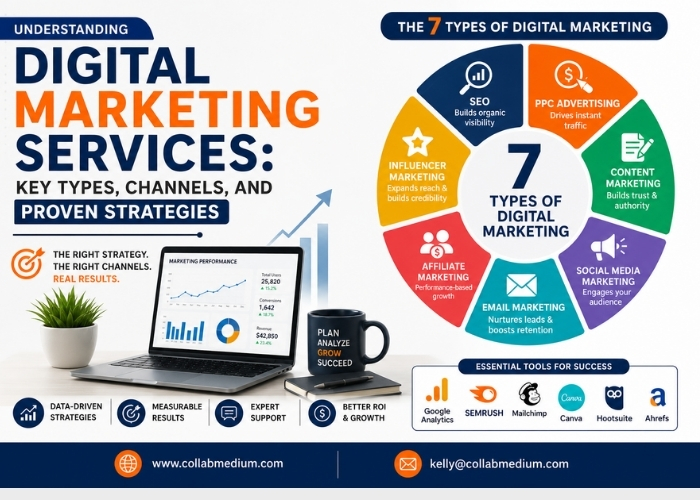
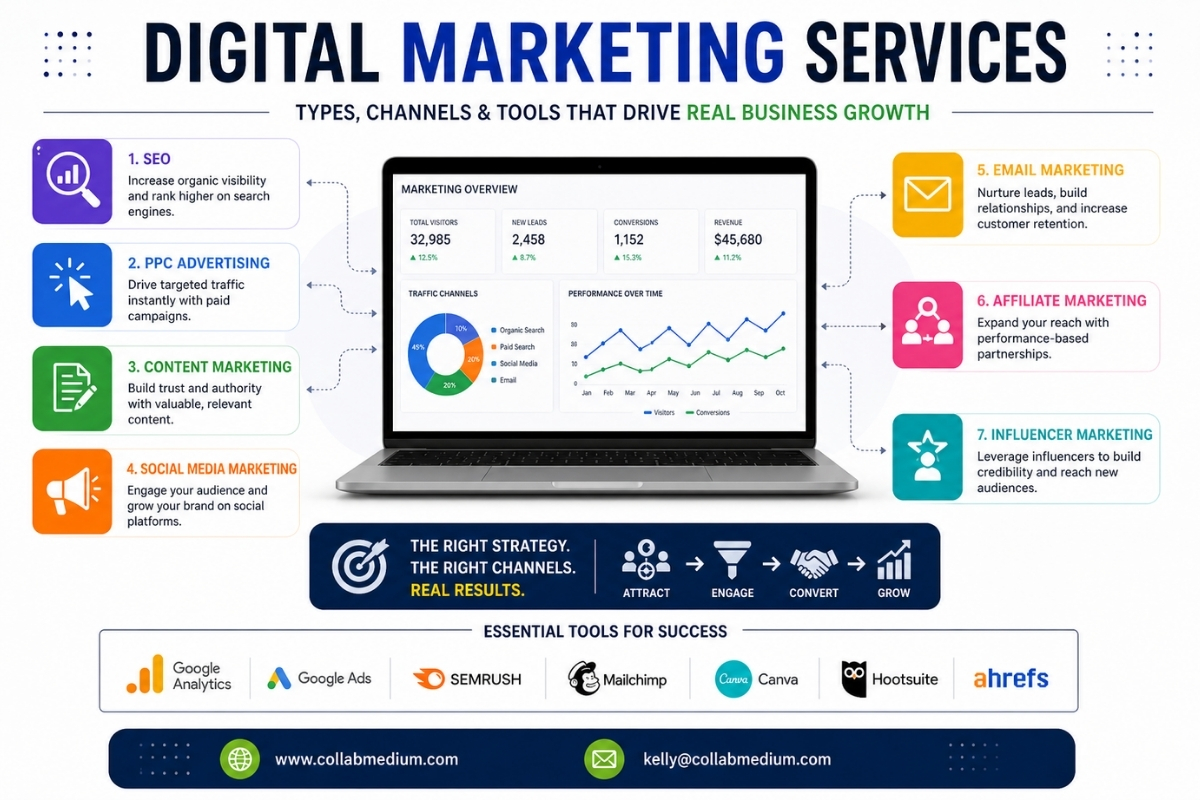
Understanding the seven types of digital marketing helps you choose the right services for your business goals. Let me walk you through each one clearly.
| Type | Primary Goal | Best Tools & Platforms | Timeline to Results |
| SEO | Organic search visibility | Ahrefs, SEMrush, Google Search Console | 3–6 months |
| Content Marketing | Brand authority, trust | HubSpot, WordPress, Clearscope | 2–4 months |
| Social Media Marketing | Audience engagement | Meta Business Suite, Hootsuite, Buffer | Immediate |
| PPC Advertising | Fast paid traffic | Google Ads, Microsoft Advertising | Days |
| Email Marketing | Lead nurture, retention | Mailchimp, Klaviyo, ActiveCampaign | 1–2 weeks |
| Affiliate Marketing | Performance-based growth | ShareASale, Impact, PartnerStack | 1–3 months |
| Influencer Marketing | Social proof, reach | AspireIQ, Grin, CreatorIQ | Campaign-based |
Each type solves a different problem. Knowing which problem you have right now is the starting point for choosing the right digital marketing service mix.
Search Engine Optimization (SEO)
SEO is a long game. It builds traffic that compounds over time. You create valuable content, optimize your site’s technical health, and earn backlinks from trusted sources. Google rewards sites that demonstrate expertise, authority, and trustworthiness.
Tools like Ahrefs and SEMrush help you find the right keywords. Google Search Console shows you what’s already working. Agencies like Victorious and WebFX specialize in SEO campaigns that deliver sustainable organic growth.
Pay-Per-Click Advertising (PPC)
PPC gives you instant visibility. You pay each time someone clicks your ad. Google Ads dominates this space, but Meta Ads Manager gives you powerful audience targeting options for social advertising.
PPC works best when your landing page and ad messaging align perfectly. A great ad sending traffic to a weak page still fails. I’ve seen businesses burn $10,000 in a month without a single meaningful lead, just because the landing page wasn’t optimized.
Content Marketing
Content marketing is how you build trust at scale. You publish blog posts, videos, guides, and podcasts that answer your audience’s real questions. Over time, this positions your brand as the go-to expert in your industry.
Companies like HubSpot and Semrush built empires on this strategy. Their blogs attract millions of monthly visitors, many of whom eventually become customers.
Social Media Marketing
Social media connects your brand to your audience where they already spend time. Each platform serves a different demographic. LinkedIn works well for B2B. Instagram and TikTok drive B2C engagement. Facebook remains powerful for local businesses and paid social campaigns. Consistency beats frequency. Posting three times a week with a strong strategy outperforms daily posting with no direction.
Email Marketing
Email still delivers the highest ROI of any digital channel. According to Litmus, every $1 spent on email marketing generates an average return of $36. Platforms like Klaviyo, ActiveCampaign, and Mailchimp make it easy to automate sequences, segment audiences, and personalize messages.
Affiliate and Influencer Marketing
These two channels rely on third-party trust. Affiliate marketing pays commission to partners who send you customers. Influencer marketing pays creators to promote your brand to their followers. Both work best when you choose partners whose audience genuinely matches yours.
How to Choose the Right Digital Marketing Services for Your Business
Before you hire any agency or invest in any tool, answer these three questions honestly.
- What is your primary business goal right now? Fast leads, brand awareness, or long-term organic growth?
- What is your realistic monthly budget? Most professional digital marketing services start at $1,500 to $3,000 per month for meaningful results.
- How much time can you invest in the process? Marketing requires your feedback and input. Agencies need direction, not just a check.
If you need leads within 30 days, PPC is your fastest path. If you’re building for 12 months from now, invest in SEO and content marketing today. Most growing businesses need both, along with email marketing as the conversion engine in the middle.
Common Mistakes That Kill Marketing Results
Skipping the Strategy Phase
Many businesses jump straight into posting ads or publishing content without a documented strategy. Strategy means knowing your target audience deeply, your messaging, your funnel, and your success metrics. Without it, you’re just guessing.
Ignoring Data and Analytics
Google Analytics 4 (GA4) and platform-native dashboards give you detailed insight into what’s working. Yet many businesses never look at their data consistently. If you don’t measure it, you can’t improve it.
Hiring Based on Price Alone
Cheap digital marketing services almost always cost more in the long run. Low-cost providers often use black-hat SEO tactics, produce generic content, or run poorly targeted ads. I’ve cleaned up countless marketing disasters that came from hiring the cheapest option available.
Expecting Overnight Results from Organic Channels
SEO and content marketing are long-term investments. Expecting page-one rankings in two weeks leads to frustration and bad decisions. Set realistic expectations before you start.
The Tools Every Business Should Use
You don’t need to spend a fortune on tools. Start with these essentials and expand as you grow.
- Google Search Console: Free, powerful, and essential for SEO monitoring.
- Google Analytics 4 (GA4): Track every traffic source and user behavior on your site.
- Canva: Create professional social media graphics without a design team.
- Mailchimp: Start your email list for free and automate basic sequences.
- Semrush or Ahrefs: Invest in one of these for keyword research and competitor analysis.
- Buffer or Hootsuite: Schedule social media posts efficiently across platforms.
For a deeper look at how these tools integrate into a full marketing stack, Moz’s Beginner’s Guide to SEO is one of the most comprehensive free resources available.
What a Real Digital Marketing Strategy Looks Like in Practice
Let me give you a real-world example. A mid-sized e-commerce brand selling outdoor gear came to me with no organic traffic and a heavy reliance on paid ads. Their cost-per-acquisition was climbing, and margins were shrinking.
We built a three-phase strategy. First, we launched a content marketing program targeting informational search queries. Second, we set up an email automation sequence that captured leads from blog readers. Third, we retargeted warm audiences with PPC ads on Google and Meta.
Within eight months, their organic traffic grew by 340%. Their email list reached 12,000 subscribers. And their paid ad spend dropped by 30% while sales held steady. That’s what a connected system of digital marketing services does.
Measuring Success: The Metrics That Actually Matter
Vanity metrics like follower counts and page views feel good but rarely reflect real business growth. Focus on these instead.
- Cost Per Acquisition (CPA): How much does it cost to win one new customer?
- Customer Lifetime Value (CLV): How much revenue does a customer generate over time?
- Conversion Rate: What percentage of visitors take the action you want?
- Email Open and Click Rates: Are your messages actually reaching and engaging your list?
- Organic Traffic Growth (month over month): Is your SEO investment paying off?
Review these metrics monthly. Adjust your strategy every quarter. Annual reviews are too slow in today’s fast-moving digital landscape.
Frequently Asked Questions
What are digital marketing services?
Digital marketing services are professional solutions that help businesses promote their products or services online. They include SEO, paid advertising (PPC), content marketing, social media management, email marketing, affiliate marketing, and influencer marketing. Agencies and freelancers deliver these services to help brands attract traffic, generate leads, and grow revenue.
What are the seven types of digital marketing?
The seven types of digital marketing are: (1) Search Engine Optimization (SEO), (2) Pay-Per-Click Advertising (PPC), (3) Content Marketing, (4) Social Media Marketing, (5) Email Marketing, (6) Affiliate Marketing, and (7) Influencer Marketing. Each type targets a different stage of the customer journey and works best when combined with complementary channels.
How much do digital marketing services cost?
The cost of digital marketing services varies by scope and provider. Freelancers typically charge $50 to $150 per hour. Small agencies start at $1,500 to $3,000 per month for basic packages. Full-service agencies managing SEO, PPC, and content together can charge $5,000 to $20,000 or more per month. Your budget should reflect your revenue goals and the competitiveness of your industry.
Which digital marketing service delivers the fastest results?
Pay-Per-Click (PPC) advertising delivers the fastest results. Once your campaign goes live, your ads appear in front of your target audience immediately. You can start seeing clicks and conversions within days. However, PPC requires ongoing ad spend to maintain results. For long-term, compounding growth without continuous ad budget, SEO and content marketing are the better investment.