
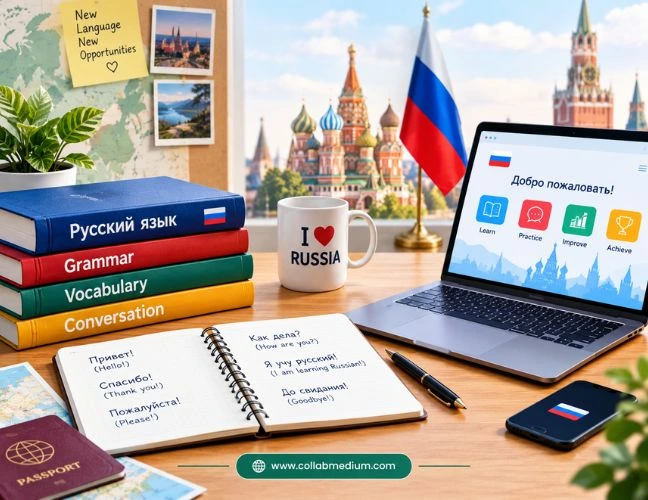
If you want to learn the Russian language the smart way, the short answer is this. Pair daily spaced-repetition vocabulary drills with real conversation practice from week one. Expect steady progress over 6 to 12 months rather than a quick fix. The best way to learn Russian is to combine a structured app for grammar and vocabulary with a tutor or exchange partner for speaking. Skip either piece and you stall out. Russian rewards consistency far more than raw talent. Most learners who quit do so because they tried to memorize grammar rules in isolation. They never practiced those rules inside real sentences. This guide walks through exactly how hard the language really is. It also covers how long it takes, which tools work best, and the mistakes that trip up almost every beginner who decides to learn the Russian language on their own. By the end, you will have a clear, realistic plan you can start today.
How Hard Is It To Learn Russian, Really?
I will not sugarcoat this. If you want to learn the Russian language, you are taking on one of the tougher challenges available to an English speaker. The Foreign Service Institute, which trains U.S. diplomats, places Russian well above Spanish or French in required study time, estimating roughly 1,100 class hours to reach professional working proficiency. That is nearly double what Spanish demands.
Here is the part most guides skip. The difficulty is front-loaded. The Cyrillic alphabet looks intimidating on day one. Most learners read it comfortably within one to two weeks, since several letters already resemble their Latin counterparts. The real challenge shows up in the grammar. Russian uses six grammatical cases. These cases change noun and adjective endings depending on their role in a sentence, and that system takes real repetition to internalize. Once you push past the first few months, though, the curve flattens noticeably. People who stick with a routine for even ninety days tend to describe a real turning point around that mark.
I always tell people that the emotional difficulty matters as much as the technical difficulty. You will feel behind. You will mix up cases in a sentence and freeze mid-conversation. That is normal, and it happens to every single person who chooses to learn the Russian language instead of an easier option.
How Long Does It Take To Learn Russian?
This is the question I get asked constantly, and the honest answer depends on your goal. Maybe you want conversational comfort: ordering food, chatting with a host family, following a simple podcast. That level is realistic in 6 to 12 months with about an hour of focused practice daily. If your goal is professional fluency, budget closer to two years of consistent part-time study, aligned with that 1,100-hour FSI estimate. Either way, the people who reach their goal fastest are the ones who track their weekly hours instead of guessing at their progress.
Here is a rough breakdown based on daily commitment:
| Study Commitment | Cyrillic Reading | Basic Conversation | Comfortable Fluency |
| 15–20 min/day | 3–4 weeks | 12–18 months | 3–4 years |
| 45–60 min/day | 1–2 weeks | 6–12 months | 18–24 months |
| 2+ hours/day (intensive) | 1 week | 3–4 months | 10–14 months |
Notice that the intensive column is not just faster, it compounds. More daily exposure means fewer forgotten words between sessions, which is the single biggest reason casual learners plateau.
What Is The Best Way To Learn The Russian Language?
The best way to learn the Russian language is not a single app or course. It is a routine that stacks four elements: input, output, correction, and repetition. Skip correction and you build bad habits into your accent and grammar. Skip output and you build a passive vocabulary you cannot actually use in conversation.
I recommend starting with 20 minutes of app-based vocabulary and grammar drills each morning. Close the day with 15 to 20 minutes of speaking practice, even if that just means talking to yourself about your day. Add one real conversation with a native speaker or tutor twice a week, and you have a routine that actually works. This is the same core structure I recommend to anyone juggling a full-time job with a new hobby.
If you are also exploring how to pick up a language from scratch more generally, this detailed walkthrough on how to learn a new language covers the foundational habits that apply well beyond Russian. It explains how to structure your first month so you do not burn out early, which matters just as much no matter which language you pick.
Best Apps To Learn Russian Language
A handful of apps consistently show up in successful learners’ routines, and each one solves a different piece of the puzzle.
- Duolingo handles bite-sized daily vocabulary and basic grammar patterns, useful for building a habit early on.
- Pimsleur focuses on audio-first listening and speaking, which helps with the pronunciation and stress patterns that trip up Cyrillic readers.
- Anki lets you build custom spaced-repetition flashcard decks, ideal once you have enough vocabulary to start reinforcing it long term.
- Lingvist uses an adaptive algorithm to prioritize the words you are most likely to forget. It has offered a free public beta version since 2014.
- italki connects you directly with native tutors for one-on-one conversation practice, filling the speaking gap that apps alone cannot cover.
No single app replaces real conversation, but combining two or three of these covers input, repetition, and correction without overwhelming your schedule.
Free Online Platform Options
You do not need a paid subscription to make real progress. A solid free online platform can carry a beginner through the first six months comfortably.
Language Reactor is a browser extension originally built for subtitle-based learning. It lets you watch Russian shows and films with dual-language subtitles, turning passive screen time into vocabulary exposure. Community forums and language exchange groups on Reddit and Discord connect you with native speakers willing to trade practice time for free. Tandem-style exchange apps pair you with a Russian speaker learning English, so you both practice for free in a genuinely reciprocal setup. Any dedicated free online platform, whether it is an app, a forum, or an exchange community, works best when you treat it as one piece of a bigger plan rather than the whole plan itself.
If your interest in language learning extends beyond Russian, this guide on how to learn English breaks down a similar free-first approach that works for any second language. It is a useful comparison point if you are weighing which language to prioritize first before committing to a full year of study.
Common Mistakes That Slow Down Russian Learners
I have watched the same handful of mistakes derail motivated learners over and over.
The biggest one is studying grammar rules in isolation instead of inside full sentences. Memorizing a case-ending chart feels productive, but it does not transfer to speech unless you practice the case inside real, spoken examples. The second mistake is avoiding speaking until you feel ready. Nobody feels ready. Waiting for confidence before you speak just delays the exact practice that builds confidence.
A third mistake is ignoring stress patterns. Russian stress is not fixed to a syllable position. Mispronouncing it can genuinely change a word’s meaning or make it unrecognizable to a native listener. Finally, many learners abandon writing practice entirely and focus only on listening apps. That habit leaves reading comprehension weak later on, right when it matters most for anyone serious about continuing to learn Russian past the beginner stage.
Pro Tips From Experience
Label household objects with sticky notes in Russian during your first month. This forces passive repetition throughout your day without extra study time. Watch children’s cartoons in Russian before jumping to adult shows, since the vocabulary and sentence structure are simpler and the pacing is slower.
Keep a small notebook of the five words you forget most often and review it before bed. This targets your actual weak spots instead of generic review. Set a realistic milestone instead of a vague one. Try ordering a coffee in Russian or holding a two-minute conversation, rather than aiming for something as fuzzy as “become fluent.” Vague goals are nearly impossible to measure, and they are easy to abandon.
According to current global speaker data, Russian remains one of the ten most spoken languages on the planet. It has roughly 145 million native speakers and 65.2 million second-language speakers as of 2026. That reach means you will find practice partners, media, and communities almost anywhere you look. Consistent exposure is far easier to maintain than with a less widely spoken language, which is one more reason so many people choose to learn Russian over a smaller regional option.
Whatever your reason for choosing to learn Russian this year, from travel to career opportunities to family connections, the process rewards patience over intensity spikes. Show up daily. Speak before you feel ready. Let the six-case system become familiar through repetition rather than memorization alone. That combination, more than any single course or app, is what actually gets people to fluency in 2026.
FAQs
Is it realistic to learn the Russian language as a busy adult with limited time?
Yes, 20 to 30 minutes daily is enough for steady progress. Consistency matters more than long, infrequent study sessions.
What is the fastest way to learn Russian for a trip?
Focus on survival phrases, numbers, and Cyrillic reading for two to three weeks before travel, paired with a phrasebook app.
Do I need to learn Cyrillic before starting grammar?
Yes, reading Cyrillic first takes one to two weeks and makes every other resource, from apps to textbooks, immediately usable.
Can I become conversational without a tutor?
It is possible using exchange apps and online communities, but a tutor speeds up correction and prevents bad habits from setting in early.