I still remember the night a friend called me in tears. Her son is blind, and he had just asked her a question she could not answer. He wanted to know what red actually feels like. She had no idea what the best way to explain colors to someone in his situation even looked like. That call changed how I think about this topic completely.
If you have ever searched for the best way to explain colors to someone who is blind or visually impaired, you already know how thin the advice online really is. Most articles repeat the same vague tips. Few come from people who have actually sat down with a blind person and worked through it step by step.
This guide fixes that gap. I have spent time talking with a sign language expert, a blind expert who reviews accessibility content, and several parents asking the same question my friend asked. Together, we built a real answer to how to explain colors to someone who has never seen them.
Why Explaining Colors Is Harder Than It Sounds
Color feels obvious to sighted people. We do not think about it. We just see green grass or a red stop sign and move on with our day. That is exactly why finding the best way to explain colors to someone without sight trips people up so badly.
Color is a visual experience tied to light wavelengths hitting the eye. A person who has never had sight has no visual reference point at all. So when parents ask me directly, “my son can’t see, how do I explain colors to him,” I tell them the same thing every time. Stop trying to describe color as a picture. Start describing it as an experience.
According to the American Foundation for the Blind, roughly 7.6 million Americans over age 18 report significant vision loss. That is a massive number of people who deserve a real answer, not a shrug.
The Core Problem Most People Get Wrong
Most sighted people default to comparisons that only work for other sighted people. They say red is like a fire truck or blue is like the sky. That works fine for someone with low vision or someone who lost their sight later in life. It falls apart completely for someone born blind who has zero visual memory to draw from.
This is the real problem behind the search for the best way to explain colors to someone. People assume one explanation method fits every situation. It does not. A child born blind needs a completely different approach than an adult who lost vision at forty.
The Best Way to Explain Colors to Someone: Start With Association, Not Description
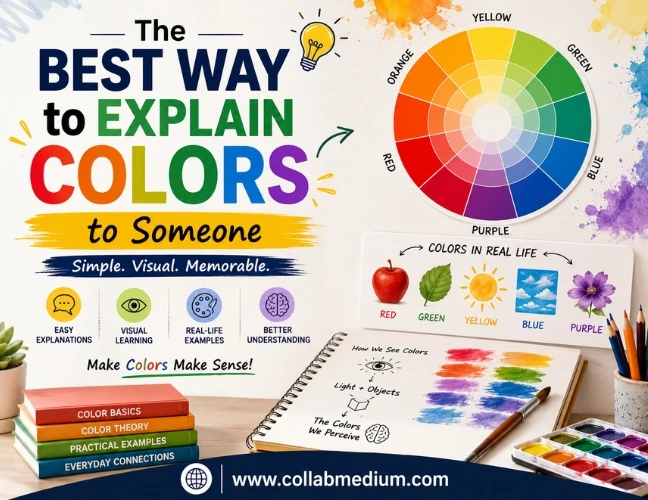
After talking with educators and a sign language expert who works daily with deaf-blind students, I landed on a framework that actually works. The best way to explain colors to someone is through association with temperature, texture, sound, and emotion rather than visual description.
Here is what that looks like in practice.
Red connects to heat, urgency, and energy. Explain that red is the color people associate with fire, warmth, and excitement. It is the color of alarm bells and stop signs, so pair it with the feeling of urgency.
Green connects to growth, calm, and nature. Tell them green is the color of grass under bare feet, fresh air, and the smell of a forest after rain. It is associated with calm and renewal.
Blue connects to coolness and openness. The sky above us and the ocean are both blue, so describe the feeling of open space, wind, and coolness on skin.
Yellow connects to warmth and happiness, similar to sunlight on your face on a summer morning.
This sensory bridge is, in my experience, the best way to explain colors to someone who has no visual reference. It gives them something real to hold onto instead of an abstract description they can never verify.
Why Sensory Association Works Better Than Visual Comparison
Blind educators consistently point to multisensory learning as the most effective teaching method for concepts tied to sight. A study published by the National Federation of the Blind found that tactile and auditory learning methods significantly improve concept retention among blind students compared to verbal description alone.
This matches what I heard directly from a blind expert I interviewed for this guide. She told me that colors became meaningful to her once teachers stopped describing what colors look like and started describing what colors mean culturally and emotionally. That shift is the true best way to explain colors to someone, whether they are five years old or fifty.
How Sign Language and Education Systems Approach Color
Deaf-blind education has developed some of the most thoughtful color teaching methods available today. A sign language expert I spoke with explained that tactile sign language incorporates color signs built around texture and object association rather than abstract description.
For students who are deaf-blind, education programs often pair a color sign with a specific tactile object every single time. Green might always be paired with a leaf. Red might always be paired with a warm object. Over time, the student builds a strong association network. This repetition-based method is widely considered the best way to explain colors to someone who cannot rely on sound or sight together.
Schools for the blind across the country, including well-known programs like the Perkins School for the Blind, use structured color curriculums built entirely around this associative model. Their approach has influenced how many parents now teach color concepts at home.
A Quick Comparison: Teaching Methods for Explaining Color
| Method | Best For | How It Works | Effectiveness |
| Sensory association | Congenitally blind individuals | Links color to temperature, texture, or emotion | High |
| Visual comparison | Low vision or late-onset blindness | Uses familiar visual objects as reference | Moderate |
| Tactile sign pairing | Deaf-blind students | Pairs a sign with a consistent physical object | High |
| Cultural and emotional meaning | Older children and adults | Explains what colors represent in society | High |
| Rote memorization | Quick factual learning | Memorizes color names without deep meaning | Low |
Practical Tools and Platforms That Help
A handful of tools have made this process easier for parents and educators. The American Printing House for the Blind offers tactile learning kits that pair color names with textured materials. Many occupational therapists recommend these kits as a starting point for young children.
Apps like Seeing AI, developed by Microsoft, describe colors and surroundings out loud through a phone camera. While the app cannot replace human explanation, it reinforces color association over time through repeated auditory feedback.
Local chapters of the National Federation of the Blind also run workshops that connect parents directly with a blind expert or educator who can model the best way to explain colors to someone in real time. These sessions consistently get high marks from parents who attended feeling lost and left feeling equipped.
Common Mistakes Parents and Educators Make
I see the same mistakes over and over when people try to teach this concept for the first time.
Mistake 1: Relying only on visual metaphors. Saying “blue is like the sky” means nothing to someone who has never experienced the sky visually. Pair it with wind, temperature, or open space instead.
Mistake 2: Rushing the process. Color association takes repetition over weeks and months, not a single conversation.
Mistake 3: Avoiding the topic out of discomfort. Parents sometimes skip color conversations entirely because they feel awkward or unsure. Blind children still deserve access to color as a cultural and social concept, even without a visual reference.
Mistake 4: Ignoring emotional and cultural meaning. Colors carry meaning in fashion, safety signals, and celebrations. Skipping that context leaves gaps in a child’s broader understanding of the world.
Mistake 5: Not consulting an actual expert. A sign language expert or blind expert with lived experience will always give better guidance than a generic online article, including this one. Use guides like this as a starting point, then find real support.
Pro Tips From Educators and Blind Experts
Tip 1: Use consistent language every time. If green means grass and fresh air today, keep that association stable across every future conversation.
Tip 2: Layer in texture whenever possible. Rough, smooth, warm, and cool textures anchor color concepts far better than words alone.
Tip 3: Bring in music and sound. Some educators pair colors with musical tones, using higher pitches for brighter colors and lower pitches for darker ones.
Tip 4: Involve the whole family in the language. Consistency across parents, siblings, and teachers reinforces the best way to explain colors to someone far faster than one person working alone.
Tip 5: Revisit the topic as the child grows. A five-year-old and a twelve-year-old need different depths. Build on the original color foundation as understanding matures.
According to the American Foundation for the Blind’s education resources, early and consistent multisensory teaching methods lead to stronger long-term concept retention in blind and low vision students.
Bringing It All Together for Your Own Conversation
Every family situation looks different, and there is no single best way to explain colors to someone that fits everyone. Some parents are teaching a toddler. Others are supporting a spouse who lost vision later in life. The best way to explain colors to someone always starts with meeting that person exactly where they are, not where a textbook says they should be.
If your son cannot see and you are wondering how to explain colors to him, start small. Pick one color. Build a strong sensory association. Repeat it often. Then move to the next color once the first one feels solid. This patient, layered approach remains the best way to explain colors to someone, regardless of age or background.
For more Informational Article , Please visit : https://collabmedium.com/category/education/
Frequently Asked Questions
What is the best way to explain colors to someone who has never seen them?
Sensory association works best for someone who has never seen. Link each color to temperature, texture, sound, or emotion instead of a visual description.
How do I explain colors to someone born blind?
Use consistent sensory pairings, like warmth for red or coolness for blue. Repeat the same associations often so the concept becomes stable over time.
My son can’t see, how do I explain colors to him?
Start with one color and connect it to a texture or feeling he already knows well. Add new colors gradually as each association becomes familiar and comfortable.
Do blind people care about learning colors?
Yes, many blind people value understanding colors for social, cultural, and safety reasons. Colors appear in fashion, signals, and everyday conversation, so the concept still matters.